
When Everything Looks Real, Nothing Is Trusted
In the generative AI era, the visual gap between authentic and synthetic content has effectively closed. That shift has moved the burden of proof in B2B marketing. Buyers now arrive at a vendor’s claims from skepticism first, and the verification signal has to appear before the claim can land. Brands gaining ground are the ones that have built trust as visible infrastructure, moving compliance credentials, data provenance documentation, and security posture from the back office to the front of the buyer journey. That is the core argument behind compliance-first marketing and the authenticity proof gap: in a market where any asset can be fabricated, proof is the persuasion.
There was a time when polish carried authority. A clean website, a confident brand voice, a well-produced video, and a polished white paper didn’t prove a company was credible, but they often created the feeling of credibility. They lowered resistance. They suggested competence. They gave the buyer enough surface evidence to keep moving.
That world still exists in fragments, but its assumptions are breaking. Generative AI didn’t simply make content cheaper. It changed the psychological environment in which content is received. A synthetic asset assembled in seconds can now resemble something that took hours, days, or weeks of human labor. A brand can produce scale, fluency, and confidence without those qualities necessarily corresponding to expertise, care, process, or institutional seriousness.
When everything can look real, appearance stops functioning as evidence.
The authenticity proof gap names that problem. It is the distance between what a brand claims to be and what a buyer can actually verify. Once that gap becomes visible, much of modern marketing starts to look structurally misaligned with the world it’s trying to persuade.
The Burden of Proof Has Moved
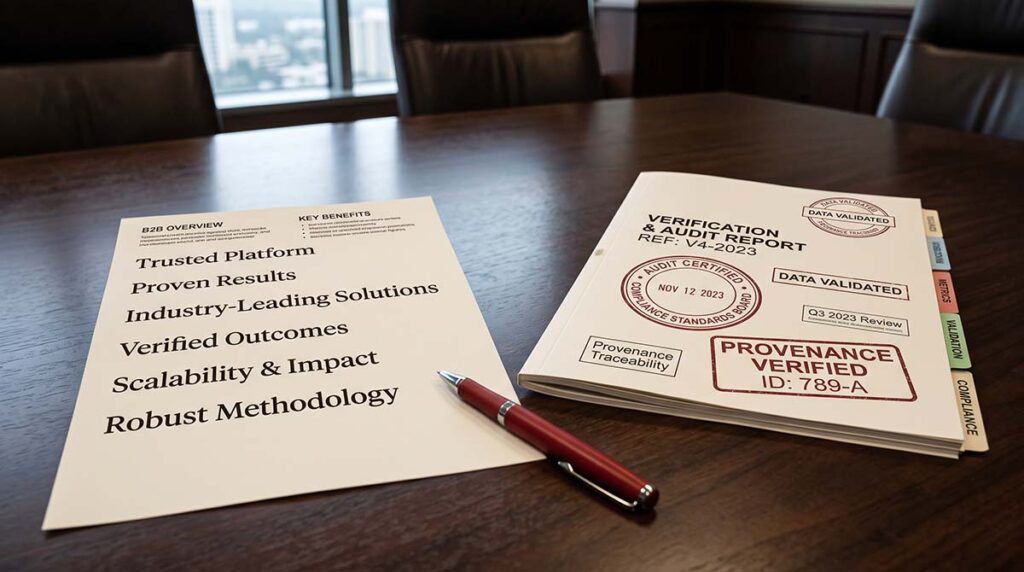
Traditional marketing assumed that credibility was the default. A company made a claim, and the buyer evaluated it. Skepticism existed, of course, but it usually followed some perceived reason for doubt. The claim arrived first. The objection came second.
That order has changed. Buyers now arrive at skepticism first. They’re adapting to an environment in which the cost of believing too quickly has gone up. In a market saturated with synthetic content, exaggerated claims, automated outreach, manufactured authority, and frictionless brand performance, the buyer can’t afford to treat every claim as provisionally true.
The burden shifts.
The brand no longer gets to make the claim and wait for the buyer to question it. The verification signal has to appear before the claim lands. The proof has to be visible early enough to shape the frame through which the buyer interprets everything else.
Confident marketing can now create the opposite of its intended effect. A phrase like “trusted by industry leaders” once operated as a credibility cue. Without external verification, it can feel like another ungrounded assertion. “Best-in-class” no longer sounds strong. It sounds unprovable. “Proven results” raises the immediate question: proven by whom, according to what, and where is the evidence?
The more polished the claim, the more suspicious it can become when nothing beneath it can be inspected.
Why Buyers Are Evaluating More Than the Product
The most important psychological turn in the enterprise buying process happens beneath the surface of ordinary evaluation. A vendor thinks the buyer is asking, “Does this product work?” The buyer is often asking something closer to, “What happens to me if this doesn’t?”
That distinction changes everything.
By the time a B2B deal reaches serious evaluation, the buyer is no longer simply comparing features. They’re managing exposure. They’re thinking about procurement scrutiny, security review, implementation risk, internal reputation, budget accountability, and the career consequences of choosing badly. The product may still matter, but the product is no longer the whole decision.
The buyer is reading for the risk case. Many marketing systems fail here. They keep speaking to the use case. They lead with performance language, feature comparisons, emotional benefits, customer outcomes, and confident positioning. Those things may be relevant, but they don’t resolve the buyer’s deeper anxiety. They don’t answer the question that emerges once the deal becomes consequential.
Is this a defensible decision? That is the question verifiable proof answers. Persuasion doesn’t answer it. Confidence doesn’t answer it. A stronger adjective doesn’t answer it. Proof does.
The Department of No Was Actually Holding the Asset

Inside many organizations, the external demand for proof collides with an internal architecture built for a different era. Revenue teams have often treated legal, security, and compliance as the Department of No. These are the teams that slow down campaigns, complicate copy, delay launches, request changes, and introduce friction into the commercial process. From the marketing side, compliance can look like a defensive cost center. It is something to get through.
That framing made sense when the main function of compliance was to prevent the company from overclaiming, misstating, exposing itself, or creating legal risk. Compliance existed behind the scenes, mostly as a brake.
The market has changed faster than the internal metaphor. The same assets that once looked like operational paperwork now function as commercial proof. Security documentation, privacy commitments, regulatory adherence, audit histories, certifications, data provenance, model governance, content credentials, and risk management protocols have become trust signals.
Many organizations still hide them. Privacy policies sit in the footer. Security documents sit behind forms. Compliance certificates appear only after a buyer asks. Trust evidence arrives late, often in the due diligence phase, after skepticism has already accumulated. The company may have the proof, but it has placed the proof where it can’t shape first perception.
That is a self-inflicted wound.
Compliance-First Marketing Is a Structural Reversal
Compliance-first marketing doesn’t turn marketing into legal copy. It doesn’t make the brand sterile, timid, or bureaucratic. It reorganizes the buyer journey around verifiable trust.
The mechanics of risk management move from the back of the room to the front of the experience. Audits, certifications, security posture, data ethics, content provenance, privacy architecture, and regulatory commitments stop being things the organization can produce if asked. They become things the buyer encounters before they ask.
That timing matters.
A proof signal delivered late answers doubt after it has formed. A proof signal delivered early changes the conditions under which doubt forms in the first place. It frames the company as legible, accountable, and easier to defend internally. It reduces the buyer’s cognitive load because the buyer no longer has to hunt for evidence or wonder whether the evidence exists.
The distinction may sound administrative. It isn’t. Information architecture becomes trust architecture. What appears first determines what everything else means.
The Trust Center Is More Than a Technical Page
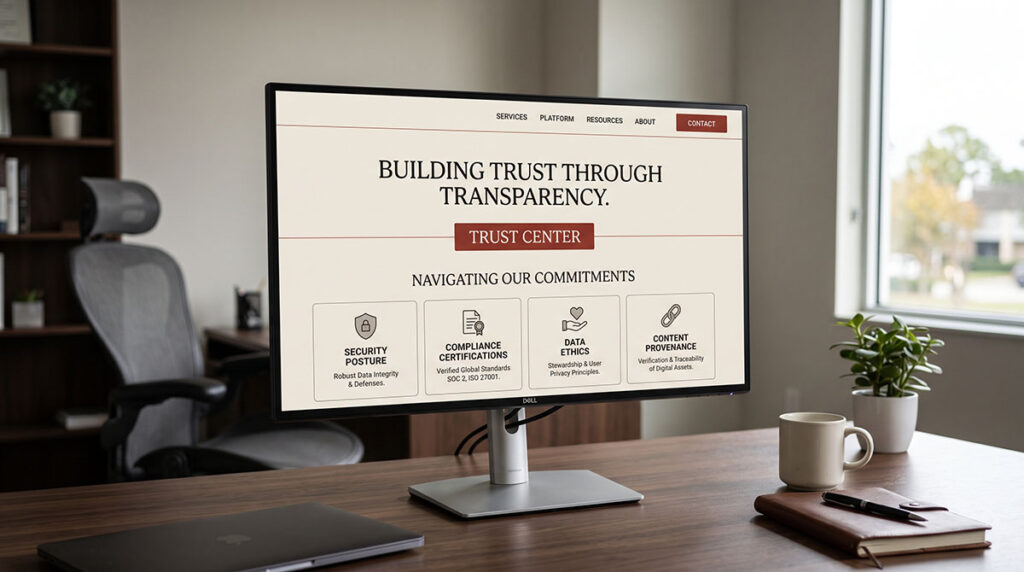
A unified trust center is often treated like a convenience feature: a place to consolidate security documentation, compliance certifications, privacy policies, and vendor risk information. That undersells what it represents.
A trust center changes when trust enters the sales process. Instead of appearing after an NDA, after a request, after procurement escalation, or after a legal delay, proof becomes publicly available at the top of the buyer journey. The buyer doesn’t have to ask whether the company has a security posture. The company has already made that posture visible. The buyer doesn’t have to wonder whether data ethics exist as a real operating principle. The company has already documented it.
The buyer doesn’t have to treat compliance as a buried internal system. It has become part of the front-facing brand architecture. This changes the theory of persuasion.
The old theory led with promise and supported it with proof later. The new theory leads with proof because the promise won’t be trusted without it.
Transparency Strengthens the Vendor
Many organizations hesitate at this point because transparency feels like exposure. Showing internal mechanics can feel risky. Disclosing limitations can feel like handing ammunition to competitors. Making risk controls visible can feel like inviting scrutiny.
The concern is understandable. It is also increasingly wrong.
In a skeptical market, opacity doesn’t protect the vendor. It transfers work to the buyer. The buyer now has to investigate, request, verify, escalate, interpret, and defend. That work is friction. And friction compounds.
Transparency reduces that cost. When a vendor voluntarily discloses limitations, documents its controls, explains its data practices, and makes verification easy, it changes the buyer’s emotional posture. The buyer no longer feels managed. The buyer feels oriented. That distinction matters because trust is often built through the absence of perceived manipulation.
Honesty becomes commercially valuable because it reduces the work required to believe responsibly. In this context, transparency is operational efficiency.
Responsible Reach Replaces Blind Reach
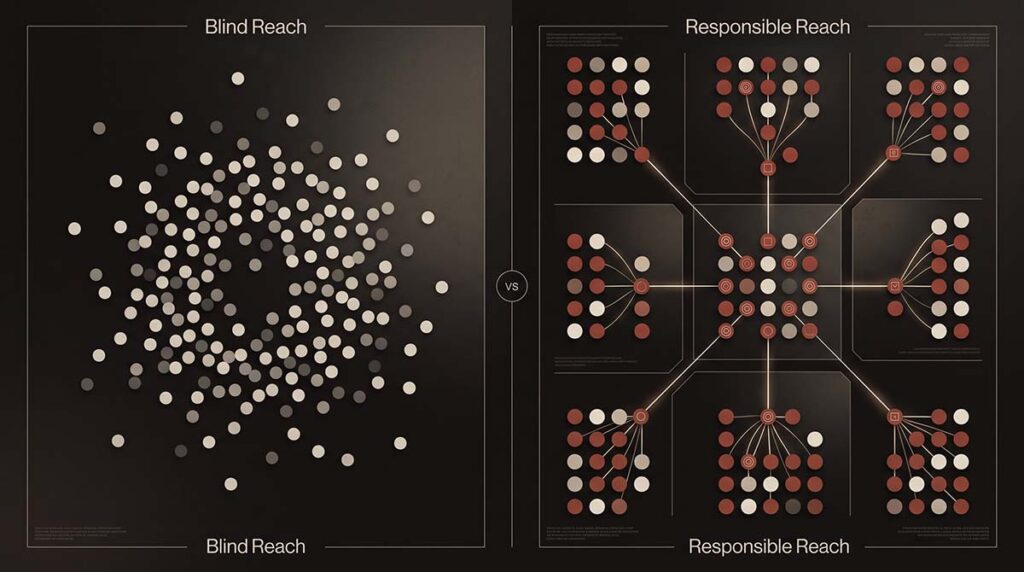
For years, marketing systems rewarded reach at scale. More impressions, more campaigns, more content, more touchpoints, more surface activity. The assumption was that volume created opportunity.
That model becomes weaker when reach can’t survive scrutiny.
High-volume, unverified campaigns may generate activity, but they don’t necessarily generate trust. They can fill the top of the funnel with contacts who arrive cold, skeptical, and unsupported by prior evidence. Sales then inherits the burden of proof conversation by conversation. Every interaction begins at zero.
Responsible reach operates differently. It is about reaching people with signals that can hold up under inspection. Cryptographic content credentials, first-party data ethics, transparent sourcing, public compliance documentation, verified social proof, and visible trust infrastructure all change the quality of the encounter. The buyer is given a reason to treat the brand as more legible than its competitors.
Reach that can’t be audited is increasingly fragile. Reach that can be proven compounds.
Compliance Becomes a Moat

The most important strategic implication is that proof is harder to copy than messaging. A competitor can imitate language. It can redesign a website. It can produce content. It can adopt the same category vocabulary and make the same claims. It can’t instantly replicate the infrastructure behind verifiable trust.
It can’t fake years of compliance maturity. It can’t instantly produce credible data provenance. It can’t manufacture an operational security posture overnight. It can’t build cross-functional alignment between marketing, legal, security, and executive leadership simply by changing copy.
This is why compliance becomes a moat.
Every proof signal a company places in front of a buyer creates a claim competitors must match. But matching the claim requires building the underlying system. The advantage is not the badge, the trust center, the audit, or the disclosure in isolation. The advantage is the organizational reality those signals reveal.
The brand has moved beyond saying, “Trust us.” It is saying, “Here is the structure that makes trust reasonable.”
The Market No Longer Extends the Benefit of the Doubt
The loudest brand used to win more often than it should have. That was a reasonable model in an environment where attention was scarce, polish was expensive, and the buyer’s default posture was more trusting than skeptical.
Those conditions no longer hold.
The market is becoming more defensive. Buyers still respond to narrative, identity, clarity, and confidence. Those signals now operate inside a verification environment. The story has to survive contact with evidence. The claim has to survive procurement. The content has to survive the possibility that it was fabricated.
The brand has to survive the question: can you prove it? What you say about your brand still matters. What you can demonstrate now matters more.
For organizations willing to see the shift clearly, that is not bad news. It means trust can be built with more discipline, more structure, and less dependence on performance. It means the companies that have done the real work can finally make that work visible.
The future belongs to the brands whose credibility can be inspected.
Frequently Asked Questions
Why are brands that can prove the integrity of their content gaining ground on those that only claim it?
Generative AI has made authentic and synthetic content harder to distinguish at a glance, so buyers now default to skepticism rather than provisional trust. A brand that can produce verifiable proof through compliance documentation, data provenance, and cryptographic content credentials removes part of the buyer’s investigation burden. That can shorten sales cycles, increase confidence, and make the brand easier to defend internally.
What is the authenticity proof gap?
The authenticity proof gap is the distance between what a brand claims to be and what a buyer can actually verify. Once synthetic and authentic content can look the same, unverified claims stop working as credibility signals and begin functioning as friction.
What is compliance-first marketing?
Compliance-first marketing moves an organization’s risk management infrastructure into the visible buyer journey. Audits, certifications, data provenance trails, security posture, and regulatory adherence stop sitting in internal documentation and start functioning as visible trust signals.
What is a Unified Trust Center, and why does it matter for B2B sales?
A Unified Trust Center is a consolidated, publicly accessible place where a vendor makes its security posture, data ethics commitments, and compliance credentials available early in the buyer journey. It changes when trust is established, which changes the frame through which later claims are evaluated.
What does data provenance mean in a B2B marketing context?
Data provenance is the documented origin and handling history of a piece of data. In a B2B trust context, it gives buyers and procurement teams evidence of responsible data practices instead of asking them to accept a policy claim.
Doesn’t disclosing limitations hurt the sale?
Early disclosure can strengthen trust because it reduces the buyer’s suspicion that the vendor is managing or concealing the truth. When limitations, controls, and data practices are visible early, the buyer has less investigative work to do and less reason to assume manipulation.
What is responsible reach, and how does it differ from traditional high-volume campaigns?
Responsible reach is brand positioning built on signals that can be audited, proven, and held up under scrutiny. Traditional high-volume campaigns may generate activity, but they often leave buyers with the burden of verification. Responsible reach gives buyers proof alongside exposure.
Why do compliance assets function as a competitive moat?
Proof is harder to copy than messaging. A competitor can imitate language, redesign a website, or adopt the same category vocabulary quickly. It cannot instantly replicate years of compliance maturity, operational security posture, or cross-functional alignment between marketing, legal, and security.