

Why the Way You Organize Information Determines Whether AI Can Use It
AI systems cite content that can be cleanly retrieved, chunked, encoded, and matched to a query. Strong writing helps the human reader, but answer-centric search depends on structure: headers, semantic chunking, vector embeddings, BLUF architecture, and atomic answer blocks all shape whether information survives the ingestion pipeline. The shift from SEO to GEO is a structural reorganization of visibility itself.
AI systems cite content that can be cleanly retrieved, chunked, encoded, and matched to a query. Strong writing helps the human reader, but answer-centric search depends on structure: headers, semantic chunking, vector embeddings, BLUF architecture, and atomic answer blocks all shape whether information survives the ingestion pipeline. The shift from SEO to GEO is a structural reorganization of visibility itself.
Search changed through behavior before most organizations noticed. A user types a technical question into a modern search interface and receives a synthesized answer. The system has already read across sources, assembled a response, and embedded citations directly into the text. The familiar ritual of query, scan, click, evaluate, and compare has been compressed into a single generated output.
That compression changes the meaning of visibility. For years, digital marketing was built around findability. The goal was to rank, attract the click, bring the user to the site, and let the page carry the argument. In that world, traffic was visible proof that the brand had been found. In an answer-centric environment, the user may never visit the page. The answer may be delivered before the click ever happens.
The core question has changed. Can people find you still matters. Can the machine retrieve you now matters earlier.
When a brand is missing from the generated response, it has been excluded from the answer-making process. Its information may exist somewhere on the web, but it did not enter the system at the moment of synthesis.
The objective has shifted from being findable to being retrievable.
The New Visibility Problem

Generative engine optimization, or GEO, emerged because search visibility now depends on machine retrieval. Traditional SEO was built around a search environment where pages competed for ranking and users selected from visible options. GEO responds to an environment where AI systems retrieve, summarize, and cite information directly.
That distinction matters because machines don’t evaluate content the way human readers do. A person can move through a dense article, infer missing context, connect a statistic to an earlier paragraph, and recognize that an argument is building across several sections. A retrieval system has to ingest documents, divide them into usable pieces, encode those pieces mathematically, compare them against a query, and decide what to retrieve.
Many organizations still look for the problem in the wrong place. They examine keywords, topics, positioning, publication schedules, domain authority, and writing quality. Those things still matter, but they no longer describe the whole system.
The more uncomfortable question is structural. Can the machine extract the information? That question pushes the analysis below the visible page and into the code layer, the document hierarchy, the section boundaries, the way headers are written, the way facts are grouped, and the way answers are placed inside the content.
Whether a brand gets cited or ignored is being decided before a user ever reads a word. It’s being decided in the ingestion pipeline.
Why Unstructured Content Creates Friction
Most organizations produce content in the format humans are used to consuming: narrative prose. Blog posts, essays, white papers, emails, thought leadership articles, commentary, analysis, research summaries, and long-form explainers are usually built around flow. They introduce context, develop an argument, support the claim, and eventually arrive at a conclusion.
That structure can work beautifully for a human reader. A retrieval system experiences it as cost.
Large language models can process prose, but extracting a clean fact from a dense paragraph is different from extracting a value from a structured field or a direct answer block. Narrative prose often wraps the important point in qualification, context, rhetoric, transition, and elaboration. The fact is present, but it has to be separated from everything around it.
That separation requires work. This creates a systemic bias against unstructured content. The bias does not come from weak ideas or poor writing. It comes from extraction cost.
The system rewards ease of extraction before it rewards the elegance of the prose. This is the first major reframe. The format of a document, not merely its argument, determines whether the machine will work to retrieve it.
The Context Window Forces the Cut

A document entering an AI retrieval pipeline immediately runs into a physical constraint. A model cannot ingest every long document as a single complete object. It faces a constraint called the context window: a fixed limit on how much text can be processed at once. A 5,000-word white paper, a long blog post, or a dense technical guide cannot simply be treated as one uninterrupted unit in many retrieval workflows.
The document has to be broken down. Modern answer engines often handle this through retrieval-augmented generation, or RAG. In a RAG system, documents are divided into smaller segments called chunks. Those chunks are indexed for later retrieval. When a user asks a question, the system searches for the chunks most relevant to that query, retrieves them, and uses them to generate an answer.
The document gets chunked. The decisive issue is how.
How the system decides where to cut determines whether the meaning survives.
Naive Chunking and the Destruction of Meaning

Weak structure gives the pipeline very few reliable signals. There may be paragraphs, but no clear conceptual hierarchy. There may be section titles, but they may be vague or ornamental. There may be long stretches of argument without crisp answer boundaries.
In that environment, the system may fall back on a simpler method: naive chunking. Naive chunking slices content according to a fixed character or token count. It does not care whether the cut occurs at the end of a complete idea. It does not know whether a statistic is being separated from the sentence that explains it. It does not know whether the subject of a sentence has been severed from its predicate.
It just cuts when the counter reaches the limit. The metaphor is a machine with scissors and a ruler.
Picture a printed essay on a table, cut every twelve inches from the left margin. The resulting pieces still contain the original words. Technically, the information still exists. But the meaning has been damaged. A claim may be separated from its evidence. A number may be separated from its label. A conclusion may be separated from the reasoning that makes it intelligible.
That is the quiet failure mode. The data is still technically in the database. It has just been rendered incoherent.
Why Broken Chunks Fail Retrieval
After content is chunked, each piece is converted into a numerical representation called a vector embedding. This embedding is meant to capture semantic meaning in a mathematical form. When a user asks a question, the system compares the query against stored embeddings and looks for the closest matches.
The retrieval process depends on the chunk meaning something coherent. A chunk that contains a complete question, a direct answer, and supporting context can produce an embedding with clear semantic shape. A chunk that contains a severed sentence, a floating statistic, half a claim, and disconnected context produces a weaker representation. It may no longer represent the actual point of the original document.
That is where citation loss happens. The document existed. The useful information existed. The failure occurred because the useful information was broken apart before retrieval.
Incoherent chunks produce degraded vectors. Degraded vectors fail similarity tests. Failed similarity tests mean the content is not retrieved.
Your document is not ranked lower. It is not retrieved at all.
The discard happens before the AI begins composing the answer.
How Structured Content Survives the Pipeline

Structured documentation behaves differently. Consider a well-organized developer documentation page. It has a clear H1 that names the primary subject. It has H2s that divide the subject into meaningful subtopics. Those H2s may be written as direct user questions. Beneath each header, the answer is presented clearly, followed by supporting detail, examples, tables, or code.
To a human reader, that may simply look organized. To a machine, it is a map.
AI crawlers and retrieval systems can treat HTML tags, headers, and section boundaries as signals of conceptual hierarchy. The H1 tells the system what the document is about. The H2s tell the system where meaningful subtopics begin. The sections provide boundaries that can be used to preserve context.
This enables semantic chunking. Instead of cutting blindly at fixed intervals, semantic chunking uses logical boundaries. It groups the header with the related content. Subject stays with predicate. Data stays with its explanation. The answer stays with the question that frames it.
The chunk that enters the index means something. This is why structured documentation often performs better in AI retrieval environments. Its advantage is not general editorial neatness. Its advantage is that the format gives the machine the boundaries it needs to preserve meaning.
That’s engineering.
Why Question-Based Headers Matter
Header language is one of the most important structural choices in the document. A traditional article might use clever, thematic, or abstract section headings. Those headings may be pleasing to human readers, but they often provide weak retrieval signals. They gesture toward a topic without directly naming the user’s question.
Question-based headers work differently. A header like “How does semantic chunking improve AI retrieval?” mirrors the shape of a real user query. When that header is paired with a direct answer beneath it, the section becomes a self-contained question-and-answer unit.
This matters because retrieval systems are matching user queries against stored chunks. If the chunk already contains a close version of the question and a clean answer, the system can recognize its relevance more easily.
The structure aligns with the behavior of the interface. The user asks a question. The document contains that question. The answer follows immediately. The machine does not have to infer the relationship from several paragraphs of narrative build-up.
The architecture reduces ambiguity.
BLUF: Giving the Machine the Answer First
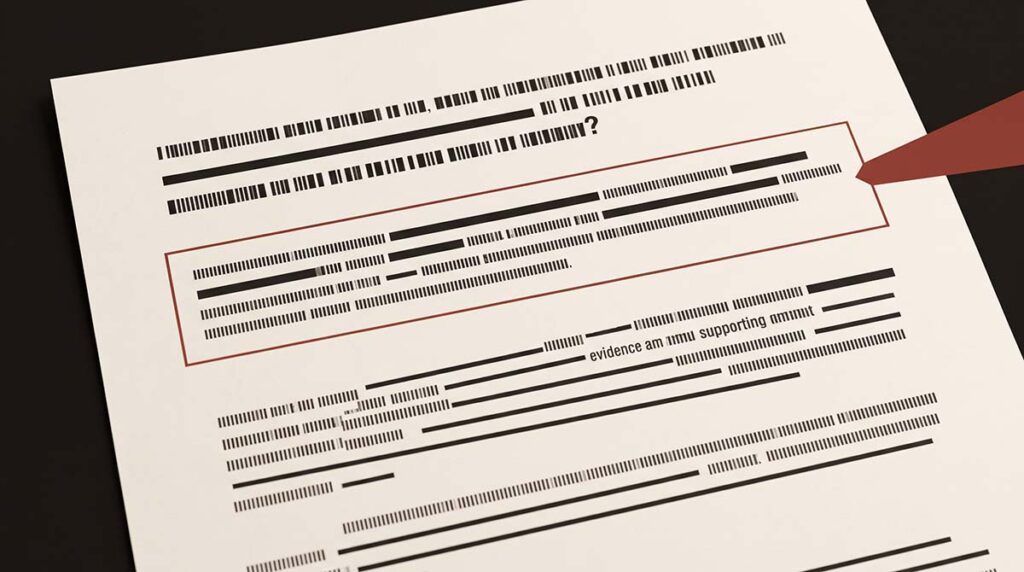
Structured formatting helps the document enter the right kind of chunking process. BLUF architecture helps a specific section become citation-ready.
BLUF stands for Bottom Line Up Front. It comes from communication environments where the conclusion needs to appear before elaboration. In GEO, the principle is straightforward: after each meaningful header, place a direct, factual answer before the longer explanation begins.
This answer block should be concise, specific, and self-contained. It should not tease the point. It should not begin with throat-clearing. It should not require the reader to keep going before the central answer appears.
The point comes first. This matters because the retrieval system is looking for content that directly answers the user’s question. A BLUF block is already shaped like an answer. It reduces the machine’s work. It gives the system a clean candidate for extraction and citation.
The old content habit builds toward the conclusion. The GEO habit states the conclusion, then supports it.
Depth still matters. The task is to separate the answer from the elaboration so the machine can retrieve the answer and the human can still read the full context.
You are not writing only for the reader who lands on the full page. You are writing so that when your excerpt is cited inside a synthesized answer, the excerpt says the right thing.
The Statistical Logic Behind Structure
Structure follows the operational logic of retrieval. AI systems favor formats that reduce ambiguity and extraction cost. Tables, clear headers, modular sections, answer-first blocks, and coherent metadata all make information easier to identify and retrieve. Dense prose makes the system work harder.
Prose still has value. It needs architecture around it.
The common mistake is treating structure as a concession to machines and prose as the true expression of intelligence. In an AI retrieval environment, structure is what allows intelligence to travel. A brilliant argument trapped inside poorly segmented prose may never reach the answer layer. A plainly structured explanation may be cited because it can be extracted cleanly.
That is the uncomfortable shift. The system does not reward clarity of argument in the way humans understand it. It rewards ease of extraction.
From SEO Content to GEO Architecture
The practical response is a reorganization around retrieval. Traditional SEO often rewarded long-form pages, keyword coverage, internal linking, topical authority, and narrative completeness. Those elements still have value, but GEO introduces a different structural discipline.
The content unit becomes more modular. A section is a retrievable object, not just a paragraph in a flow. A header is a semantic boundary, not just a reader aid. A table is a machine-readable structure, not just a visual convenience. A direct answer block is a citation candidate, not just a summary.
This changes how organizations should think about their existing content libraries. White papers, blog posts, thought leadership archives, case studies, reports, and educational pages may contain significant proprietary knowledge. But proprietary data loses its value the moment the machine cannot parse it. The archive may exist. The expertise may be real. The insights may be strong. If the retrieval system cannot extract them, they do not participate in the answer.
In a zero-click environment, structure is not a formatting decision. It is a survival condition.
The Real Lesson: Machines Evaluate Architecture
Most organizations still treat content quality and content visibility as the same problem. They are different problems now.
Quality determines whether an argument is worth making. Structure determines whether the machine will ever retrieve it to make it.
This distinction is easy to miss because, for a long time, human readers were the primary endpoint. The page existed for the person who clicked. The article existed for the reader who arrived. The white paper existed for the prospect willing to download it.
Now, the machine may be the first reader. And the machine does not read in the familiar sense. It parses. It chunks. It embeds. It compares. It retrieves. It cites.
The brands that appear inside AI-generated answers are not necessarily the best thinkers in their category. They are often the ones whose information is formatted in a way the machine can efficiently extract.
That is a solvable problem. But it is not solved by writing better alone. It is solved by architecting better.
Frequently Asked Questions
Why does the way content is organized determine whether AI can use it?
AI systems retrieve information through pipelines that break documents into chunks, encode those chunks as vector embeddings, and compare them against a user’s query. Weak structure can damage meaning during ingestion. The information may exist, but fail to survive as a retrievable unit.
What is generative engine optimization, or GEO?
Generative engine optimization is the discipline of structuring content so AI systems can extract, retrieve, and cite it inside generated answers. Traditional SEO focused on rankings and clicks. GEO focuses on machine retrieval: whether information is organized in a way that lets the system use it at the moment of synthesis.
What is the context window in AI search?
The context window is the fixed amount of text a language model can process at one time. Long documents cannot always be ingested as complete objects, so retrieval systems break them into smaller pieces. That constraint makes structure important because the way a document is cut determines whether its meaning survives.
What is retrieval-augmented generation, or RAG?
Retrieval-augmented generation is an architecture that retrieves relevant chunks of information before generating an answer. Instead of relying only on what the model already contains, the system searches indexed source material, selects the most relevant pieces, and uses them to produce a response with citations or supporting references.
What is naive chunking, and why is it a problem?
Naive chunking splits content by fixed character or token counts rather than by meaning. It can cut through sentences, separate statistics from context, and isolate claims from the explanation that makes them useful. The words may remain in the database, but the argument becomes fragmented and harder to retrieve accurately.
What are vector embeddings in AI retrieval?
Vector embeddings are numerical representations of text that allow AI systems to compare meaning mathematically. When a user asks a question, the system looks for chunks whose vectors are closest to the query. Poorly chunked content can produce degraded vectors, making the source less likely to be retrieved.
What is semantic chunking, and why does structured content perform better?
Semantic chunking splits a document at logical boundaries such as headers, sections, and hierarchy. Instead of cutting blindly, the system groups related material together. A question-based H2 followed by a direct answer gives the machine a coherent unit, preserving context and making the content easier to retrieve and cite.
Isn’t good writing still enough for AI visibility?
Good writing still matters for the human reader, but it is no longer sufficient for machine retrieval. A thoughtful article can be invisible if the system cannot parse it cleanly. In an answer-centric environment, quality determines whether the argument is worth making. Structure determines whether the machine can retrieve it.