

What Happens When Spending Stops Feeling Like a Decision
Biometric checkout changes commerce because it removes more than payment friction. It removes the moment when the brain registers payment as payment. The mechanism is the collapse of distance between purchase intent and transaction through biometric authentication, tokenized cryptograms, and the bypassing of the pain of paying. That’s why frictionless checkout can increase conversion while becoming dangerous when the trust architecture is wrong. Device-bound protocols make biometric payment feel like control. Centralized biometric databases make it feel like surrender.
Checkout begins after the customer has already crossed the most important threshold. They want something. The cart is open. The form loads. The card details are waiting to be entered. The transaction is almost complete.
Companies tend to describe that moment from inside the system. Checkout becomes an operational sequence: fields, validations, payment credentials, shipping data, fraud checks, confirmation states. The buyer moves through the process, the system verifies the information, and the sale completes or fails.
Consumers experience something else entirely. Checkout is a psychological threshold.
By the time someone reaches checkout, the most important decision has already happened. They’ve decided, however briefly, that they want the thing. That desire may not be deeply rational. It may not last very long. It may be fragile, situational, emotional, and dependent on context. In that moment, it’s real.
Everything that follows either protects the decision or gives the buyer time to escape it. Checkout friction is the system’s chance to talk the customer out of a decision they had already made. It slows the body, redirects attention, increases effort, and gives hesitation room to form.
Biometric checkout matters because it does something more powerful than speed up payment. It attacks the final psychological layer between wanting and buying. It removes the mechanical work of entering payment information and weakens the emotional signal that normally makes payment feel like payment. That’s why it’s commercially powerful and socially delicate. The same technology that can make checkout feel effortless can also make identity feel exposed. That distinction, more than technical performance, determines whether consumers accept it.
Purchase Intent Is More Fragile Than Companies Want to Admit
Picture someone on a crowded train. One hand is gripping a rail. The other is holding a phone. They’re half-balanced, half-distracted, scrolling through a feed in a public space they don’t control.
An ad appears for a travel backpack. The timing is right. The product fits some half-conscious need. The image works. The price seems acceptable. They tap. They add it to cart.
From a marketing perspective, that moment looks like progress. The campaign worked. The creative performed. The targeting found the right person at the right time. The user expressed intent.
Intent is fragile. It isn’t possession, commitment, or a durable object that can survive unlimited procedural demand.
Purchase intent is an emotional state, and emotional states are perishable. They decay when the environment changes. They weaken when attention is redirected. They become vulnerable when the brain is forced into a different mode.
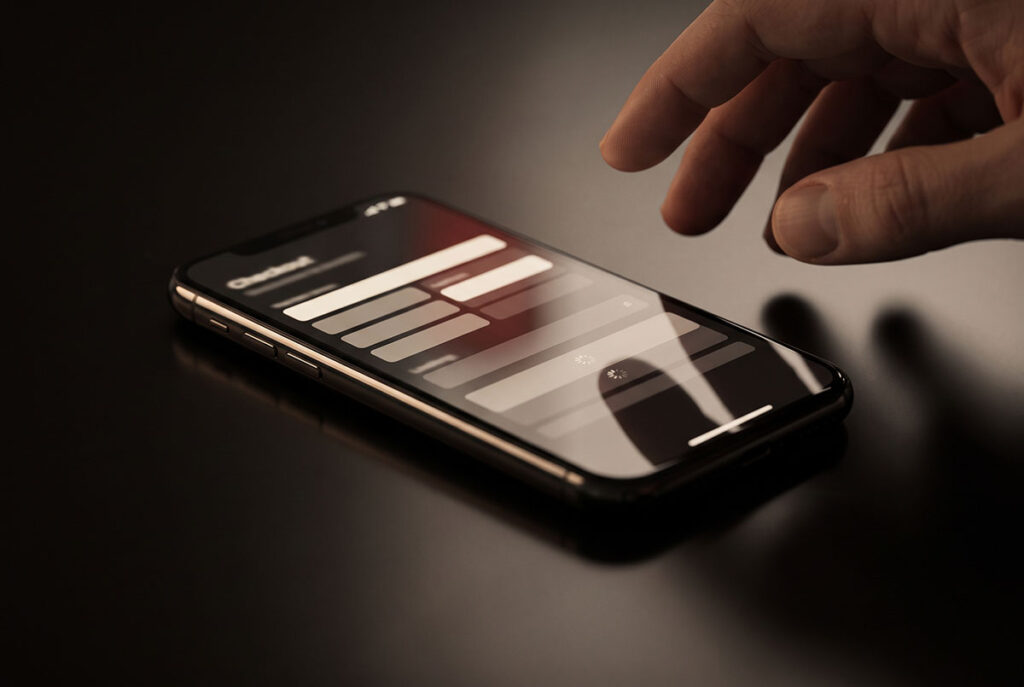
Mobile checkout often breaks that state. The purchase may begin in impulse, but the checkout form demands analysis. It asks the user to stop being a buyer and become an administrator.
A fifteen-field checkout form on a phone can become adversarial architecture. It was built for a person sitting still at a desktop keyboard and then forced onto a moving body in a distracted environment.
The buyer now has to locate a credit card, type numbers, check fields, manage errors, create an account, confirm shipping, and maintain focus. In the abstract, none of this sounds especially difficult. In the actual moment, it’s enough to break the state that created the purchase.
The brain doesn’t hold both modes at once. It switches. Once it switches, the original impulse doesn’t wait politely in the background. It dissolves.
The Financial Cost of a Broken Psychological State
The consequences show up in the data. A quarter of users abandon their carts when they’re forced to create an account. Another 24% leave because the checkout process takes too long. Those are people who wanted the product and left anyway.
That distinction matters because companies often think of abandonment as a demand problem. The product wasn’t compelling enough. The offer wasn’t strong enough. The customer wasn’t ready.
Sometimes that’s true. Often, the acquisition worked. The product worked. The desire existed. The failure happened later, inside the conversion architecture.
A badly designed form field can destroy the value created by the marketing system before the transaction ever completes. Checkout friction becomes a tax on intent. The consumer pays it in effort. The company pays it in wasted demand.
Modern checkout systems are trying to bypass forms entirely. A tokenized cryptogram, in plain terms, is a randomized credential string that can stand in for actual payment information. Instead of asking the user to manually re-enter sensitive data, the system connects a verified payment method and shipping information to the payment gateway without exposing the real card details or forcing the buyer through another round of administrative work.
The technical elegance matters less than the psychological continuity. The user taps once. The order ships. The emotional state survives.
The Pain of Paying Is a Feature, Not a Bug
The next layer is deeper than form design.
Behavioral economists have long studied what’s called the pain of paying. The phrase can sound casual, but the concept is specific. Spending money produces a negative emotional response. The transaction itself creates friction in the mind, even when the purchase is rational, affordable, and desired.
This resistance protects the consumer. It makes resource loss emotionally visible. It slows impulsive behavior. It creates a small internal checkpoint between desire and depletion.
Traditional payment methods preserve that checkpoint. Cash makes spending tangible. A credit card still requires an action that feels like payment. Manual entry creates even more awareness because the buyer must consciously participate in the transaction.
Biometric checkout changes the character of the event. When scanning your face to pay feels like unlocking your phone to check a message, the brain may not register the action as financial. The gesture is familiar. The emotional weight is light. The payment doesn’t feel free. More precisely, it may not feel like much of anything.
That is the real power of invisible checkout. It reduces effort and salience.
The transaction still happens. The money still leaves. The order still processes. But the felt experience of parting with money becomes muted, compressed, or absent.
Basket sizes can grow when checkout stops feeling like a decision because the system has removed the moment where resistance would normally activate. The consumer isn’t necessarily becoming irrational in some dramatic way. The decision environment has changed.
This is the behavioral force behind frictionless commerce. The closer intent gets to action, the more valuable that intent becomes.
The Amazon One Lesson: The Technology Worked, the Deployment Failed

A simple version of the story would say: remove friction and win. The Amazon One case makes the argument more interesting.
Amazon One achieved much of what biometric checkout is supposed to achieve. Palm scanning offered fast authentication. The system was technically impressive. It reduced friction at the point of transaction. On paper, it solved the checkout problem.
And still, Amazon discontinued the service for retail use in 2026. The technology worked. The deployment failed.
That pivot reveals the real constraint. Consumers don’t evaluate biometric systems only by whether they function. They evaluate them by the relationship the system creates between their body, their identity, and the institution asking for access.
Amazon’s model required biometric data to be transmitted into a centralized corporate database. That changes the psychological meaning of the transaction. The consumer is no longer simply using their body to authenticate payment. They’re giving an institution a version of the data that proves who they are.
That introduces existential friction.
Who owns the data that proves you are you?
Accuracy doesn’t answer that question. In fact, accuracy can make it more uncomfortable. A highly reliable biometric system is useful precisely because the biological signal is hard to fake. That same reliability makes the data feel more intimate, more permanent, and more dangerous when control shifts away from the individual.
Device-bound systems have succeeded where centralized biometric systems struggle. Face ID and fingerprint authentication work differently in the consumer imagination because the biometric data stays on the device. It isn’t transmitted to a server. It isn’t stored in a corporate database somewhere. The consumer doesn’t need to understand every technical detail to understand the basic architecture.
It’s the difference between a lockbox you carry and a lockbox someone else controls. The question reaches beyond the strength of the lock. The question is who holds the key. Consumers know the difference.
Trust Architecture Determines Adoption
Trust architecture sounds abstract, but in this context it’s concrete. It describes how a system distributes control, exposure, permission, and risk.
Two biometric checkout systems can feel identical at the point of use. Both may scan the body. Both may authenticate quickly. Both may remove manual payment steps. But if one keeps the biometric data on consumer-owned hardware and the other transmits it to a centralized database, they aren’t psychologically equivalent.
One feels like convenience. The other can feel like surrender.
Companies often make a basic mistake here. They treat trust as a messaging problem. They assume consumers need to be reassured after the architecture has already been chosen. But trust is embedded in the structure before it’s communicated at the surface.
If the structure gives control to the institution, reassuring language can’t fully remove the tension. If the structure keeps control with the consumer, the system begins with a different psychological baseline.
That’s the design constraint for biometric checkout. High authentication accuracy is achievable. Seamless interaction is achievable. Speed is achievable. The harder problem is building the system in a way that doesn’t make the consumer feel possessed by the infrastructure.
The future of checkout will belong to companies that understand both sides of the equation. They must make payment disappear without making identity feel captured.
The Real Variable Is Whether Payment Still Feels Like Payment
Retail and e-commerce teams often frame checkout optimization around visible UX elements. Shorten the form. Reduce the number of steps. Improve button placement. Offer wallet payments. Remove account creation. Make the path cleaner.
Those improvements matter, but they don’t reach the core mechanism. The real variable is whether the brain registers the transaction as a transaction at all.
That’s why biometric checkout is more than a payment layer. It is a behavioral interface between desire and consequence. It determines whether the consumer experiences buying as a deliberate act, a quick confirmation, or almost no event at all.
This is where the ethics and the economics become difficult to separate. From the company’s perspective, reducing hesitation is efficient. From the consumer’s perspective, hesitation may be protective. From the system’s perspective, the most valuable transaction is the one that completes before reconsideration has time to form.
Biometric checkout isn’t inherently bad. It is powerful. Powerful systems require architectural discipline.
The commercial case is already clear. Faster checkout reduces abandonment. Invisible payment protects momentum. Device-bound biometric authentication can make transactions feel effortless while maintaining consumer trust.
But the Amazon One lesson remains the warning. A system can be technically correct and still psychologically wrong. It can remove one kind of friction while introducing another. It can solve checkout and still fail trust.
The companies that own the next decade of commerce won’t simply be the ones that build the fastest checkout. They’ll be the ones that build the checkout consumers forget they’re using, while still letting consumers feel that their identity belongs to them.
Frequently Asked Questions
Why does biometric checkout change consumer behavior?
Biometric checkout changes behavior because it removes mechanical and psychological friction. When a purchase is completed by face scan or fingerprint, the transaction can feel like unlocking a phone rather than spending money. That bypasses the pain of paying and makes the final act of purchase less cognitively visible.
What is the pain of paying in consumer psychology?
The pain of paying is the negative psychological response triggered when someone parts with money. It isn’t regret after the purchase. It’s resistance at the moment of transaction. Biometric checkout matters because it can stop that resistance from activating in the first place.
What is a tokenized cryptogram in checkout?
A tokenized cryptogram is a randomized credential string that stands in for actual payment data during a transaction. Instead of forcing the user to re-enter card information and shipping details, the system verifies the payment through the credential and completes the purchase without exposing or manually retyping the real card data.
What does spend-ception mean?
Spend-ception describes the point where a purchase becomes functionally invisible to the consumer. The transaction still happens, but the brain doesn’t experience it as a meaningful financial event. The payment doesn’t feel free. More precisely, it doesn’t feel like anything at all.
Why did Amazon One fail if the technology worked?
Amazon One is instructive because the technical system worked in the narrow sense. The problem was trust architecture. Consumers rejected the idea of sending biological identity into a centralized corporate database. The technology removed checkout friction, but it introduced deeper friction around control, privacy, and ownership of biometric data.
What is the difference between centralized and device-bound biometric checkout?
Centralized biometric checkout requires biological data to be transmitted or stored outside the consumer’s device. Device-bound checkout keeps the fingerprint or facial map on hardware the consumer already owns. The key difference is who controls the identity layer of the transaction.
Is frictionless checkout always good for brands and retailers?
Frictionless checkout can improve conversion, basket size, and purchase frequency, but it isn’t automatically good strategy. Removing friction also removes the consumer’s moment of reconsideration. The commercial advantage is real, but it only holds when the system preserves trust and keeps biometric control with the consumer.
Is biometric checkout just another payment UX improvement?
No. Treating biometric checkout as ordinary UX optimization misses the deeper mechanism. The issue reaches beyond fewer fields or faster forms. The real variable is whether the brain registers the transaction as a transaction at all. That makes biometric checkout a psychology problem and a trust problem.