

Authenticity Became Invisible at the Worst Possible Time
C2PA, the Coalition for Content Provenance and Authenticity, is an open standard that addresses synthetic media verification by embedding a cryptographic chain of custody directly into a content asset at the moment of hardware capture. It makes authenticity a structural property of the file rather than a claim attached to it. The standard works by generating a cryptographic hash from a file’s exact pixel arrangement at capture, signing that hash with a private key, and storing the result in a tamper-evident C2PA manifest that travels with the file through legitimate editorial workflows and remains available for browser-level verification. Platform moderation, content labels, and fragile EXIF metadata can be stripped, altered, or overwhelmed by synthetic media volume. C2PA gives the file a mathematical record. When the pixel arrangement changes without an authorized, appended manifest layer, the recomputed hash won’t match the signed record. The deeper shift is architectural: trust moves from appearance and institutional claim to provable chain of custody, from the sensor to the screen.
C2PA, the Coalition for Content Provenance and Authenticity, addresses a problem that synthetic media has made impossible to ignore: real images and generated images can now arrive on the same screen with the same surface signals. The standard embeds a cryptographic chain of custody directly into the content asset, beginning at capture and continuing through edits, signatures, manifests, and browser-level verification.
A photograph taken by a photojournalist in a conflict zone and a photograph generated by an AI system from a text prompt can arrive on the same screen looking identical. Same resolution. Same apparent realism. Same metadata fields. Same visual authority. Same everything most people instinctively know how to check.
That is the uncomfortable part of the synthetic media problem. People can be careful, platforms can be overwhelmed, and generative AI can still produce convincing images. The deeper issue is that authenticity has become invisible.
For most of the digital era, people relied on a mixture of visual instinct, institutional trust, context, metadata, platform labeling, and skepticism. None of these systems were perfect, but they were culturally familiar. A photograph seemed to carry some relationship to an event. A video seemed to imply the presence of a camera. Metadata seemed to offer a trace of origin. A publisher’s reputation seemed to provide context. Even when these signals were weak, people knew where to look.
Generative AI disrupts that arrangement because it can produce media that satisfies the surface signals without sharing the underlying origin. The image can look like evidence without having been evidence. It can resemble a record without having recorded anything. It can carry the emotional force of documentation without the physical fact of capture.
Telling people to be more skeptical doesn’t solve that problem. Skepticism helps when there are signals to inspect. It fails when the signals have become indistinguishable.
The issue reaches beyond media literacy. It is an infrastructure gap.
The Old Trust System Was Built Around Appearance
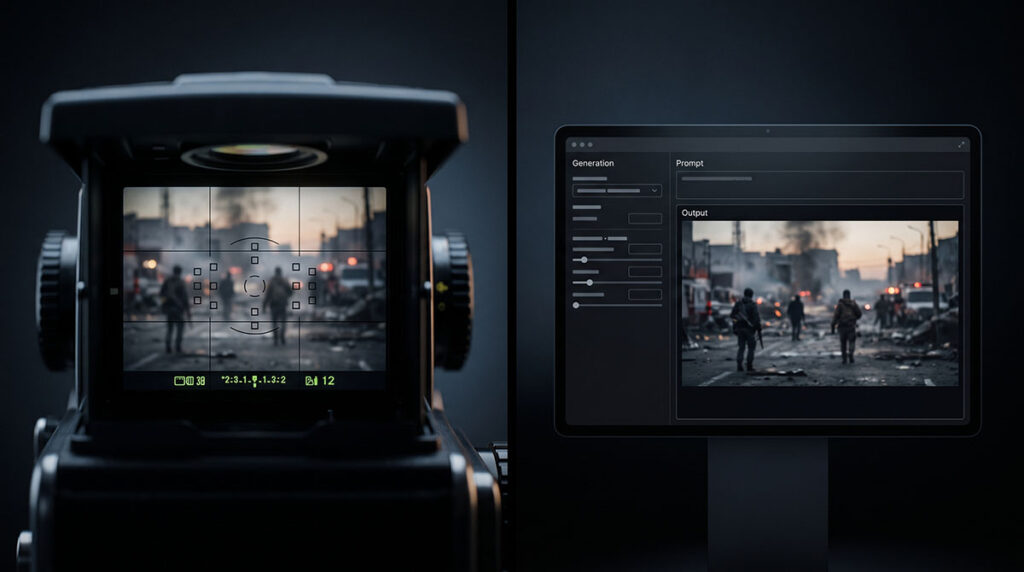
Digital media used to retain at least some intuitive connection to the physical world. A camera pointed at something. A sensor captured light. A file was created. The image could be edited, cropped, compressed, stripped, mislabeled, or misused, but the basic act of capture still implied that something had been in front of the lens.
That assumption shaped how people learned to trust images. The image did not have to prove everything. It simply had to appear plausible within a known context. A news organization published it. A platform hosted it. A caption described it. Metadata might support it. The viewer’s visual judgment filled in the rest.
This was always fragile. Photographs have always been staged, cropped, manipulated, miscaptioned, and weaponized. But the economics were different. Creating convincing false visual evidence required skill, time, access, and intent. The friction mattered.
Synthetic media changes the cost structure. It lowers the barrier to producing plausible visual evidence. It also removes the ordinary traces of physical origin. A generated image doesn’t need a place, a camera, a photographer, or a moment. It only needs a prompt and a model capable of producing a believable surface.
That is the collapse point. The viewer receives an image, but the image no longer tells the viewer what kind of event produced it.
Was this captured? Was it generated? Was it edited? Was it composited? Was it altered after publication? Did it come from a camera, a model, a newsroom, a content farm, a state actor, an anonymous account, or a legitimate source whose file was later manipulated?
The image itself cannot answer.
Why Platform Trust Is Not Enough
Misinformation has usually been met with more review. More moderators. More platform policies. More labels. More fact-checkers. More detection systems. More institutional processes layered on top of the content after it has already entered circulation.
All of that has a role. But it doesn’t scale cleanly against the volume and speed of synthetic media. Once the cost of generating plausible content approaches zero, the review burden becomes structurally lopsided. The production system scales faster than the verification system.
That is the deeper weakness in platform-centered trust. It treats authenticity as something judged after the fact, usually by an institution sitting outside the file. The platform reviews the content. The newsroom validates the content. The moderation system flags the content. The viewer waits for an external authority to interpret the object.
That model becomes unstable when content moves across platforms, gets downloaded, re-uploaded, stripped of metadata, compressed, cropped, screenshotted, clipped, translated, remixed, and reposted. Each transfer can weaken context. Each platform may apply different policies. Each copy may lose some part of its history.
Traditional metadata already showed the weakness of this approach. EXIF data and file tags can be useful, but they are fragile. They can be removed, altered, or silently stripped by social media platforms as part of normal upload pipelines. A trust signal that disappears without consequence cannot carry the burden of proof.
A standard that can be silently removed is a suggestion. This is where C2PA enters the picture.
What C2PA Is Actually Trying to Solve
C2PA stands for the Coalition for Content Provenance and Authenticity. It is an open standard designed to make the origin and edit history of digital content verifiable. The important part goes beyond labeling content. The important part is where the verification lives.
C2PA isn’t a moderation team. It isn’t a platform policy. It isn’t a fact-checking system. It is a cryptographic chain of custody embedded directly into the content asset itself.
That distinction matters. A platform policy tells you what a company has decided to say about a file. A cryptographic provenance system gives the file a verifiable history that can be checked. One is a claim around the content. The other is a structure inside the content’s lifecycle.
The easiest metaphor is a digital nutrition label, but even that metaphor needs precision. A normal nutrition label still requires trust in the manufacturer, the regulator, and the supply chain behind the claim. C2PA aims for something stronger: a record mathematically signed by the equipment and software involved in the asset’s creation and modification.
The goal isn’t to make people feel better about content. The goal is to make claims about origin and alteration testable.
Trust Begins at the Sensor
A photojournalist covering a breaking news event raises a C2PA-enabled camera and takes a photograph. The crucial moment is the shutter click. Not when the file is uploaded. Not when the image reaches a publisher. Not when a social platform decides how to label it. At the moment of capture, the camera hardware begins generating a record.
That record can include assertions: specific logged claims about the circumstances of capture. Timestamp. GPS coordinates. Device make and model. Potentially other information about the capture environment depending on the system and implementation.
The key word is hardware. This record doesn’t originate in some later software layer that can be easily detached from the capture event. It originates at the sensor, which is the only place in the chain that was actually there.
That is the architectural distinction. Trust routed through hardware is structurally different from trust asserted by a platform. One becomes a property of the file’s origin. The other is a policy decision that can change.
The system is not magic. Hardware can be compromised. Credentials can be mishandled. Standards can be implemented poorly. But the trust model is different. It begins at the point of capture rather than at the point of dispute.
The Hash Turns the Image Into a Mathematical Object
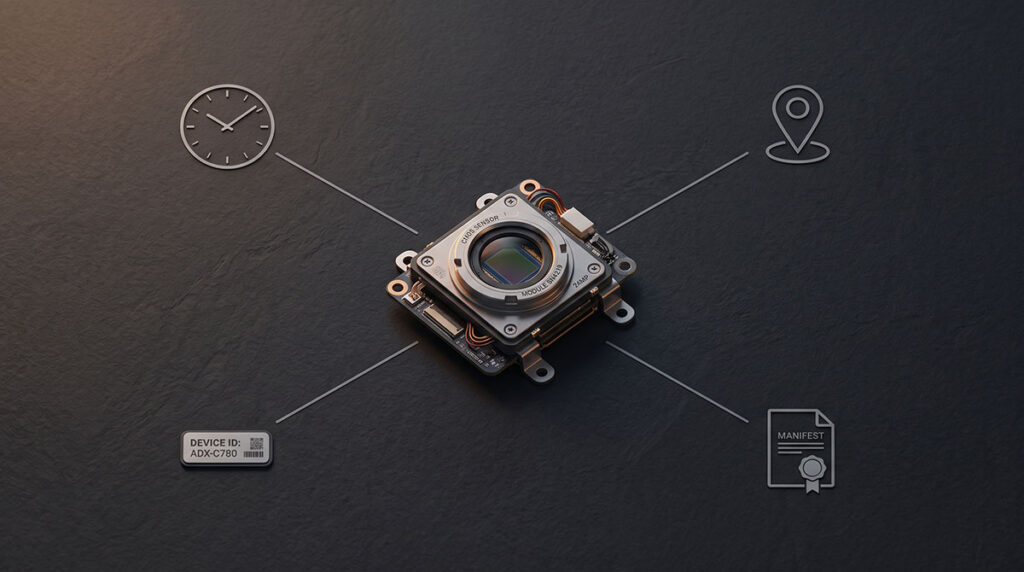
The next layer is the cryptographic hash. A cryptographic hash is a unique alphanumeric string generated from the exact contents of a file. In the case of an image, it can be understood as a mathematical fingerprint derived from the precise arrangement of pixels.
This differs from a filename, file size, or ordinary metadata. The hash is generated from the content itself. Change the content and the hash changes.
This is the part that gives the system its force. If someone alters the image by adding smoke to the background, removing a person, changing a sign, or modifying even a small part of the pixel arrangement, the newly computed hash no longer matches the original signed hash.
The image may still look plausible. It may even look more persuasive than the original. But mathematically, it is no longer the same object.
The camera signs this hash using a private cryptographic key, along with the relevant assertions about time, device, and origin. That signed information is packed into a C2PA manifest, which travels with the file.
At this point, authenticity has moved from appearance to structure. The question shifts from, “Does this look real?” to “Does this file’s current state match the cryptographically signed record of its origin and history?”
The Editorial Editing Problem
A legitimate objection appears immediately. Newsrooms don’t publish raw captures exactly as they come out of the camera. They crop images. They adjust exposure. They correct white balance. They resize files. They prepare images for publication.
If every pixel change breaks the original signature, then standard editorial work would appear to destroy the chain of custody before the public ever sees the image.
C2PA addresses this through manifest layering. When a C2PA-compliant editing application modifies an image, it doesn’t overwrite the original signature. It appends a new layer. A new hash is generated for the modified version. The specific edits are documented. That new manifest layer chains back to the original manifest, referencing it without replacing it.
The result is a layered record rather than a frozen object. The original capture remains verifiable. The editorial modifications sit on top of it. Each step is attributed and logged. The image can evolve through legitimate workflows while preserving its relationship to the original capture.
Legitimate editing extends the standard. That point matters because authenticity does not mean untouched. Journalism has always involved editorial judgment. Cropping is not deception by default. Exposure adjustment is not fabrication by default. Color correction is not manipulation in the malicious sense. The real question is whether the changes are visible in the record.
C2PA does not demand that media remain raw. It demands that the history of transformation remain inspectable.
Tampering Becomes Detectable

The malicious version is different. A published photograph shows a building after an incident. A bad actor intercepts the image and uses generative AI to add a smoke plume in the background. The smoke changes the apparent severity of the event. The modified image is re-uploaded without updating the C2PA manifest.
To an ordinary viewer, the image may look real. It may pass through the old visual trust system. The smoke may match the lighting, perspective, grain, and tone. It may satisfy the eye.
But the pixel arrangement has changed. When C2PA-compliant software recalculates the hash of the altered image and compares it to the hash locked in the manifest, the values do not align. The numbers do not argue. They simply do not match.
That mismatch is the system’s verdict. The scope of the claim has to stay precise. C2PA does not prevent manipulation. Nothing prevents manipulation. A determined actor can still create false images, strip provenance, generate synthetic content, or circulate files outside compliant systems.
But C2PA makes unauthorized manipulation detectable when a signed provenance chain exists and is checked. That is a narrower claim, but it is also a more serious one.
The standard does not end deception. It changes what deception has to do. It forces a manipulated file to break the chain, expose an inconsistency, or circulate without provenance.
And absence becomes meaningful.
Verification Moves to the Browser
Browser-level verification is the final step. When a viewer loads a C2PA-signed image, the verification doesn’t have to depend entirely on some distant server or moderation process. The browser or app can independently recalculate the hash of the pixels being rendered. It can compare that result against the hash stored in the manifest.
If the hashes align, the system can surface Content Credentials: a human-readable record showing the verified hardware origin, the edit ledger, and whether generative AI was involved in the asset’s lifecycle.
This is the digital nutrition label idea in its most useful form. It gives the viewer a way to inspect origin and transformation without relying solely on visual judgment.
The full workflow becomes understandable in three stages. At origin, hardware captures and signs the initial hash. During the lifecycle, compliant editing software appends a transparent, chained record of changes. At verification, the browser confirms that the pixels being viewed match the cryptographically signed record.
The trust does not ask the viewer to believe anything. It shows the math.
The Deeper Shift Is Architectural
The deeper implication of C2PA is architectural. For decades, much of the response to misinformation has assumed that the answer is more judgment after publication. More moderation. More review. More policy. More detection. More institutional labeling. More people and systems trying to sort truth from falsehood once content is already moving through the network.
But synthetic media exposes the limits of that model. You cannot moderate your way out of a mathematical problem.
That line matters because it identifies the category error. If the cost of producing plausible false content collapses, then a review-based trust system is always reacting from behind. It is trying to inspect the flood after the flood has already begun.
C2PA offers a different type of answer. It embeds verifiability into the content itself at the moment of creation, in a form that arithmetic can check later.
That is the shift from claimed authenticity to mathematical provability. It does not solve every problem. It does not remove the need for judgment. It does not eliminate propaganda, synthetic media, misleading framing, selective editing, institutional bias, or bad-faith interpretation. It also depends on adoption by hardware makers, software vendors, publishers, platforms, and browsers.
But it clarifies the problem in a way that matters. The future of trust will not be built only on better labels. It will be built on provenance systems that preserve origin, transformation, and verification as part of the media object itself.
Seeing Is No Longer Believing
The old phrase “seeing is believing” depended on a world where visual evidence still carried a relatively scarce relationship to physical capture.
That world is ending. In the synthetic media environment, seeing can still matter, but it cannot stand alone. A realistic image may be real. It may be generated. It may be edited legitimately. It may be maliciously altered. It may be stripped of context. It may be a true file attached to a false claim.
The image is no longer enough. Trust has to become more explicit. More inspectable. More architectural. More connected to origin and custody.
C2PA is important because it points toward that future. It says authenticity should not live only in the viewer’s intuition or the platform’s claim. It should be embedded into the content’s lifecycle, from the sensor to the screen.
In that sense, the most important thing about C2PA is not that it helps detect fake images. It is that it changes what authenticity means.
Authenticity stops being a surface impression. It becomes a chain.
Frequently Asked Questions
What is C2PA and what problem does it solve?
C2PA, the Coalition for Content Provenance and Authenticity, is an open standard that embeds a cryptographic chain of custody into digital content at the moment of capture. It addresses the synthetic media verification problem by making authenticity a mathematical property of the file rather than a claim made by a platform or institution.
What is a cryptographic hash in the context of C2PA?
A cryptographic hash is a unique alphanumeric string generated from the exact arrangement of pixels in an image file. Change a single pixel and the hash changes entirely. In C2PA, the camera signs this hash at capture, so any later unauthorized alteration produces a hash that no longer matches the signed original. Tampering becomes detectable by arithmetic.
What is a C2PA manifest?
A C2PA manifest is an unalterable container embedded in a content file that stores the file’s cryptographic hash, hardware origin assertions, and a chained record of authorized edits. Those assertions can include timestamp, GPS coordinates, device make and model. The manifest travels with the file, and when provenance is expected, its absence becomes a signal.
How does C2PA handle legitimate editorial editing without breaking the chain of custody?
C2PA-compliant editing software doesn’t overwrite the original signature. It appends a new manifest layer with a new hash for the modified version, a record of the specific edits, and a chain reference back to the original capture manifest. The original signature remains verifiable, while every modification sits on top of it, attributed and logged.
Does C2PA prevent synthetic media manipulation?
No, and the standard doesn’t claim to. C2PA makes unauthorized manipulation detectable when a signed provenance chain exists and is verified. A manipulated file either breaks the chain, surfaces a hash mismatch, or circulates without provenance. In a system where provenance is expected, absence of provenance becomes meaningful.
What are Content Credentials?
Content Credentials are the human-readable record surfaced by C2PA verification. They function like a digital nutrition label, showing the verified hardware origin, the edit ledger documenting changes since capture, and whether generative AI was involved at any point in the content’s lifecycle.
Why isn’t platform moderation sufficient for the synthetic media problem?
The production system scales faster than the verification system. When plausible synthetic content becomes cheap to generate, review-based trust is always reacting from behind. A moderation policy can change. A cryptographic signature locked into the file at capture gives the object a record that can be checked.
Where does C2PA verification actually happen?
Verification can happen at the browser level. When a C2PA-signed image loads, the browser independently recalculates the hash of the pixels it’s rendering and compares that result against the hash stored in the manifest. No external request. No third-party review. The math runs locally and either confirms or fails.