

Balenciaga’s 2022 Holiday Campaign Crisis
The Balenciaga holiday campaign crisis began when the company approved and published imagery showing children with teddy-bear handbags carrying bondage-coded accessories. Five days later, viewers found a genuine Supreme Court document concerning the pandering of child pornography inside a separate campaign photograph. Balenciaga had no independent ethics or compliance review mechanism with the authority to stop either campaign before publication. The company survived by withdrawing its lawsuit, accepting responsibility, creating an internal image review committee, and supporting child-protection work. Those reforms also dismantled the unchecked creative autonomy that had powered the brand’s rise.
A child stood before a camera holding a teddy-bear handbag fitted with bondage-coded accessories. Before the photograph reached the public, it passed through a global luxury company, a creative team, a production process, and whatever chain of approval Balenciaga believed was sufficient. The image was published on November 16, 2022. Five days later, another Balenciaga campaign gave the public a second piece of evidence. A genuine Supreme Court document concerning the pandering and promotion of child pornography was visible beneath a handbag in a high-resolution promotional photograph.
The campaigns were produced separately. The public connected them immediately. Commentators described what followed as an advertising scandal and a social media firestorm. Both descriptions captured the visible crisis.
Neither reached the operating decision underneath it. Balenciaga had built a culture that rewarded provocation and speed. It hadn’t built an independent ethical review mechanism with the authority to stop that culture when provocation crossed a boundary. The omission remained invisible while the system was succeeding.
Then the system produced something the company could no longer defend.
The Engine That Had No Brakes
By the fall of 2022, Balenciaga had made global attention feel routine. Under creative director Demna, the house had turned aesthetic resistance into commercial power. Trash bags became luxury objects. Platform Crocs became status symbols. Oversized hoodies carried four-figure prices.
The brand repeatedly took items that appeared excessive or deliberately unattractive and made ownership of them proof of cultural confidence. For three consecutive quarters leading into 2022, Balenciaga occupied the number one position in the Lyst Index global rankings. That was sustained market power rather than the brief rise of a novelty brand.
The products worked partly because they created discomfort. Wearing Balenciaga signaled that the customer wasn’t embarrassed by attention. The customer controlled it.
Provocation at scale requires infrastructure. Balenciaga built that infrastructure with deliberate precision and declined to build anything beside it. The creative operation moved quickly because speed was part of the advantage. Conventional judgment could be dismissed as the very thing the brand existed to challenge.
Restraint risked making the work ordinary. Additional approval risked slowing the release cycle and softening the provocation before it reached the market. The arrangement appeared rational because it produced results. Balenciaga’s shock strategy generated conversation, and conversation generated cultural authority.
The absence of friction inside the creative pipeline looked like trust in a successful creative director instead of a weakness in governance. A missing brake rarely announces itself during acceleration. The system that made Balenciaga appear bulletproof assumed that nothing Demna’s organization produced would ever require stopping. As long as the creative instinct remained inside a socially tolerable range, the assumption looked like confidence.
In November 2022, it stopped looking like confidence.
Two Campaigns, One Catastrophe
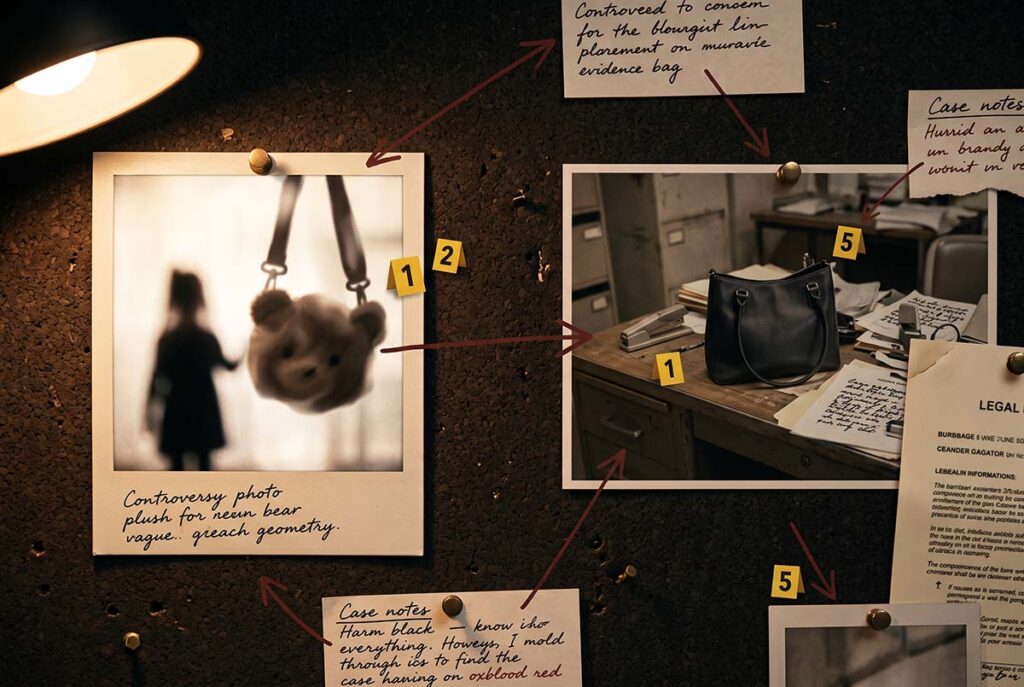
The Gift Shop campaign provided the first body of evidence. Balenciaga described its visual treatment as a reference to punk and do-it-yourself subculture. The styling was rough and recognizably consistent with a brand that had trained the market to expect provocation. The public focused on the children photographed holding teddy-bear handbags with accessories that viewers interpreted as bondage-coded.
Balenciaga expected friction around an unconventional image. It encountered a moral accusation that couldn’t be absorbed into the usual language of artistic discomfort. Five days later, the Garde-Robe campaign appeared. The photographs were set inside a Manhattan corporate office.
In one image, a document could be seen beneath a handbag on a cluttered desk. Viewers enlarged the high-resolution photograph and identified the visible text as part of United States v. Williams, a 2008 Supreme Court ruling authored by Justice Antonin Scalia. The case concerned federal statutes criminalizing the pandering and promotion of child pornography. The document was real.
Someone selected it, brought it to the set, placed it beneath the handbag, and left enough visible to enter the final photograph. Further scrutiny produced additional allegations involving props used in the campaign. Online commentators began treating both campaigns as parts of one deliberate message. Some claims expanded beyond what the available evidence could support, but the legal document prevented Balenciaga from dismissing the entire reaction as fantasy.
Two separate campaigns converged around one public interpretation. Right-wing commentators accelerated the narrative. The brand had supplied the material that made the narrative possible. Balenciaga lost approximately 100,000 Instagram followers within days.
Celebrity ambassadors publicly distanced themselves. Calls for boycotts and the destruction of the brand moved across social platforms faster than a conventional crisis team could contain them. The crisis had outgrown the question of whether one photograph was offensive. The public was examining how separate productions, with different sets and teams, had generated material that appeared to point in the same direction.
Two campaigns. Two production structures. One theme.
That pattern didn’t prove a coordinated hidden intention. It demanded an institutional explanation. Balenciaga didn’t have one ready.
The Architecture of Inevitability

The Gift Shop campaign provided the first body of evidence. Balenciaga described its visual treatment as a reference to punk and do-it-yourself subculture. The styling was rough and recognizably consistent with a brand that had trained the market to expect provocation. The public focused on the children photographed holding teddy-bear handbags with accessories that viewers interpreted as bondage-coded.
Balenciaga expected friction around an unconventional image. It encountered a moral accusation that couldn’t be absorbed into the usual language of artistic discomfort. Five days later, the Garde-Robe campaign appeared. The photographs were set inside a Manhattan corporate office.
In one image, a document could be seen beneath a handbag on a cluttered desk. Viewers enlarged the high-resolution photograph and identified the visible text as part of United States v. Williams, a 2008 Supreme Court ruling authored by Justice Antonin Scalia. The case concerned federal statutes criminalizing the pandering and promotion of child pornography. The document was real.
Someone selected it, brought it to the set, placed it beneath the handbag, and left enough visible to enter the final photograph. Further scrutiny produced additional allegations involving props used in the campaign. Online commentators began treating both campaigns as parts of one deliberate message. Some claims expanded beyond what the available evidence could support, but the legal document prevented Balenciaga from dismissing the entire reaction as fantasy.
Two separate campaigns converged around one public interpretation. Right-wing commentators accelerated the narrative. The brand had supplied the material that made the narrative possible. Balenciaga lost approximately 100,000 Instagram followers within days.
Celebrity ambassadors publicly distanced themselves. Calls for boycotts and the destruction of the brand moved across social platforms faster than a conventional crisis team could contain them. The crisis had outgrown the question of whether one photograph was offensive. The public was examining how separate productions, with different sets and teams, had generated material that appeared to point in the same direction.
Two campaigns. Two production structures. One theme.
That pattern didn’t prove a coordinated hidden intention. It demanded an institutional explanation. Balenciaga didn’t have one ready.
The Reckoning

A crisis can damage a brand through the original event and through the measures required to prevent its recurrence. Balenciaga survived the first threat by accepting the second. Kering’s Other Houses division, which included Balenciaga but wasn’t limited to it, reached €3.87 billion in revenue in 2022. The division subsequently entered a sustained commercial contraction through 2025.
That segment data can’t measure the damage caused by one Balenciaga campaign. The wider luxury market was weakening, and several Kering brands contributed to the result. It does provide context for the environment in which Balenciaga attempted its recovery. The company was rebuilding while aspirational luxury customers were pulling back.
It could no longer rely on the same provocation system to dominate attention, and the wider market offered less room for a cautious brand to recover through ordinary demand. The creative output became more controlled. Collections projected seriousness and restraint. What had once felt culturally dangerous began to feel administratively safe.
That shift wasn’t necessarily an aesthetic failure. Serious haute couture can be accomplished and critically respected. It represented a different source of value from the one Balenciaga had previously exploited. The old Balenciaga commanded attention by making the market argue about whether an object should exist.
The post-crisis brand had to demonstrate that someone responsible was watching. In 2025, Demna departed. Pierpaolo Piccioli was appointed to lead a full creative reset, bringing an identity associated more closely with romanticism and craft than calculated disruption. The house was moving forward while acknowledging that the old operating model couldn’t simply restart after a period of reputational repair.
Balenciaga’s corrective actions were substantial. The company accepted responsibility, withdrew its lawsuit, installed formal oversight, funded child-protection work, and preserved enough institutional legitimacy to continue. Those actions helped save the organization. They also dismantled the assumption on which its most successful period had been built: creative autonomy should operate without an authority capable of stopping it.
The crisis didn’t destroy Balenciaga. The survival strategy did.
Balenciaga remains an operating luxury house with global awareness, institutional resources, and the ability to rebuild under new creative leadership. The system that allowed the brand to behave as though governance belonged to less confident companies disappeared. The contradiction is uncomfortable because the reforms were necessary.
Balenciaga needed review, accountability, and formal authority over creative risk. Their absence had produced the crisis. Those controls also made the organization more legible and cautious. The brand could no longer perform the refusal of restraint that had once distinguished it.
The case extends beyond advertising ethics or crisis communications. It concerns the price of governance inside a brand whose value depends on appearing ungoverned. Every organization has a point at which autonomy becomes exposure. Most discover that point when a decision reaches the public and the missing authority becomes visible.
By then, the guardrail has become the structure the institution must build to survive. Balenciaga survived. The brand that made Balenciaga worth saving did not.
Frequently Asked Questions
What happened during the Balenciaga holiday campaign crisis?
In November 2022, Balenciaga published a campaign showing children with teddy-bear handbags carrying bondage-coded accessories. Five days later, viewers found a genuine Supreme Court document concerning child pornography pandering inside another campaign image. The two campaigns merged into one public crisis involving advertising ethics, oversight, and institutional responsibility.
Why did the Balenciaga campaigns cause such a severe backlash?
The backlash became unusually severe because the controversy extended beyond subjective claims about provocative fashion imagery. The second campaign contained a verifiable legal document from United States v. Williams. Its presence made it difficult for Balenciaga to dismiss the reaction as a misunderstanding of artistic intent or unconventional styling.
What was wrong with Balenciaga’s approval system?
Balenciaga lacked an independent compliance or ethics review mechanism with the authority to stop creative material before publication. The creative process effectively reviewed itself. Leadership either approved the disputed campaign elements, or outside contractors possessed enough control to introduce them without effective internal detection. Both explanations reveal the same structural failure.
What does creative autonomy mean in the Balenciaga case?
Creative autonomy refers to the unusual freedom given to Balenciaga’s creative operation under Demna. Speed, provocation, and resistance to conventional judgment helped the brand dominate attention. No independent authority could interrupt the process when creative experimentation moved beyond aesthetic discomfort and created a serious ethical risk.
What were the Gift Shop and Garde-Robe campaigns?
Gift Shop was the holiday campaign featuring children holding teddy-bear handbags with bondage-coded accessories. Garde-Robe was a separate campaign in which a Supreme Court document appeared beneath a handbag. Different teams produced the campaigns, but their release within five days caused the public to interpret them as one connected pattern.
How did Balenciaga respond to the crisis?
Balenciaga initially removed campaign material, restricted public interaction, redirected blame, and filed a $25 million lawsuit against a production company. It later withdrew the lawsuit, issued apologies, created an internal image review committee, involved parent company Kering, and formed a multimillion-dollar partnership with the National Children’s Alliance.
Did Balenciaga recover from the 2022 campaign crisis?
The institutional recovery was real, but it came at a permanent strategic cost. Balenciaga remained an operating luxury house and installed meaningful governance reforms. Those controls ended the era of unchecked creative autonomy that had powered its cultural relevance. The company survived, but its former operating identity did not.
What should other brands learn from the Balenciaga crisis?
Creative governance must operate as part of the creative system rather than as an obstacle added after the work is finished. Brands built on speed and provocation still need an independent authority capable of stopping publication. A missing guardrail may look efficient while decisions remain acceptable. Its true cost becomes visible after an irreversible decision reaches the public.