
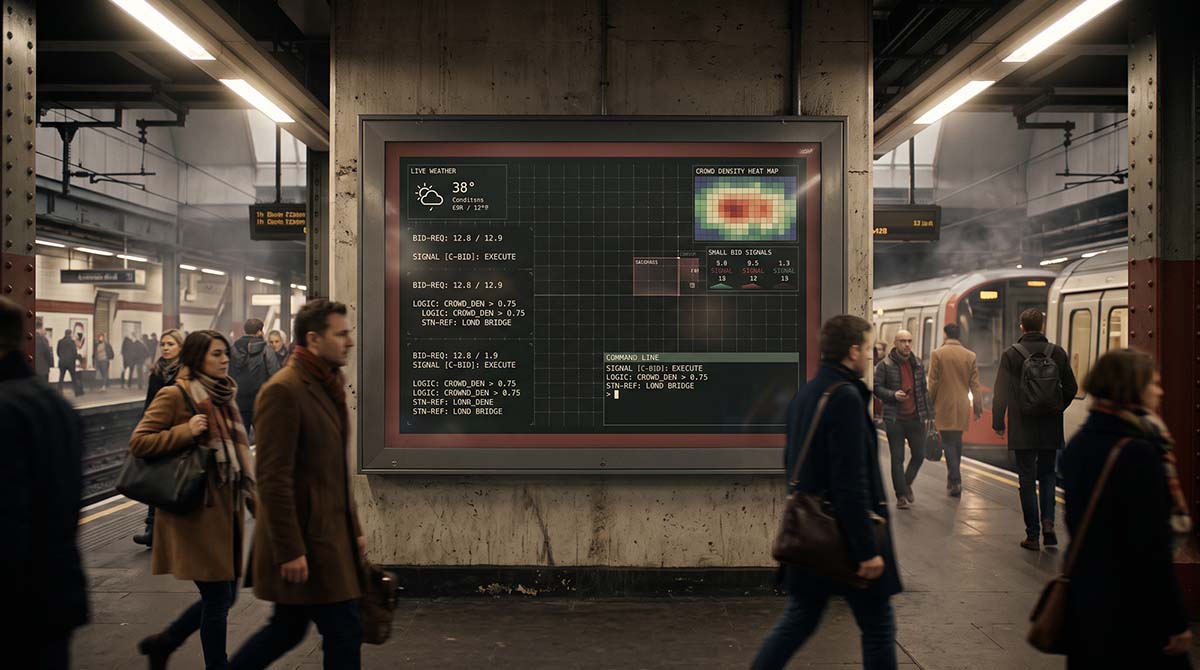
You’re Not Buying Space. You’re Buying the Moment.
Programmatic digital out-of-home advertising, or programmatic DOOH, is the automated, data-driven buying and delivery of ads on digital screens in physical public spaces. Instead of buying fixed billboard placements for scheduled time periods, advertisers use supply-side platforms, demand-side platforms, live data feeds, and conditional logic to bid on moments when specific real-world conditions are present. Weather, crowd density, audience composition, time of day, and location can all determine whether an ad appears. Dynamic Creative Optimization then serves the version of the message that best fits those conditions. The result is a shift in the unit of purchase: the advertiser buys the moment when the world matches the campaign logic.
For most of its history, outdoor advertising was easy to understand because the transaction was physical. A brand bought space. A billboard company sold access to that space. The value of the buy came from location, traffic, visibility, and duration. Put the message where enough people would see it, keep it there long enough, and some percentage of the crowd might respond.
That model made sense because the billboard itself was passive. It didn’t know who was passing. It didn’t know whether the weather had changed. It didn’t know whether the people in front of it matched the likely buyer. It occupied a position in the world and repeated the same message until the campaign ended.
Programmatic digital out-of-home advertising changes that premise. It changes the unit of purchase. The advertiser no longer simply buys a wall, an intersection, a platform, or a high-traffic corridor. The advertiser buys a specific condition in the physical world at the moment that condition becomes true.
That is the shift. The billboard has stopped selling space. It sells the moment.
The Billboard Still Looks Passive
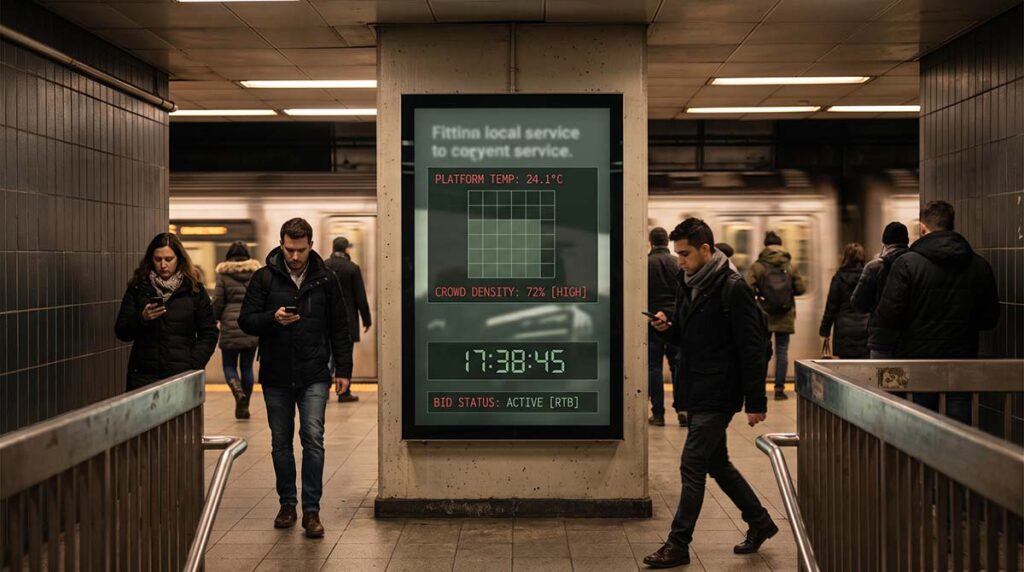
A digital billboard in a transit station still looks like a billboard. Hundreds of commuters pass it every minute. Most don’t look at it. Those who do may assume they’re seeing a pre-scheduled advertisement running on a loop, indifferent to who happens to be standing nearby.
Beneath that ordinary surface, the logic has changed.
When the temperature drops below a certain threshold, the ad can change. When a train delay causes crowd density on a platform to spike, the ad can change. When the demographic composition of the nearby audience matches a buyer’s target, the ad can change. A person didn’t notice the condition and make a call. A system detected the condition and acted on it in milliseconds.
That’s what makes programmatic DOOH more significant than a media format update. It turns the screen from a passive display into an active node. The billboard becomes part of a network that treats the physical world as live data.
The surface remains familiar. The behavior underneath does not.
From Static Contracts to Conditional Logic
Traditional outdoor media buying was built around the fixed contract. A brand or agency negotiated with a sales representative, selected a location, committed to a duration, and paid for a block of guaranteed exposure. That model carried an unavoidable assumption: the right audience would probably pass by often enough to justify the buy.
Programmatic removes much of that friction. Instead of buying weeks or months of exposure in advance, advertisers can use automated platforms to bid on screen inventory in real time. The relevant unit becomes smaller, sharper, and more conditional. The moment becomes the real unit of value.
The old question, “Where should we place this?” no longer does enough work. In a programmatic environment, the stronger question is: “Under what conditions should this message appear?”
The contract gave you a location. The algorithm gives you a condition. The industry has decided which one it prefers.
The Infrastructure Beneath the Screen
A digital billboard changing creative is easier to understand when you think less about posters and more about markets.
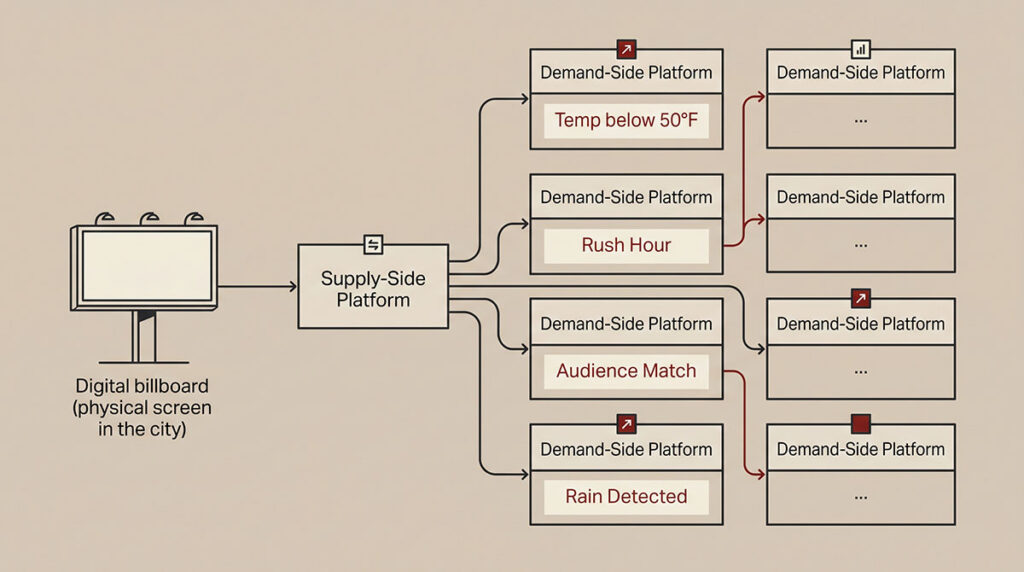
Every digital screen connected to programmatic infrastructure can function like an edge node. When inventory becomes available, that screen communicates with a supply-side platform, or SSP. The SSP makes the available screen opportunity visible to the buying side of the market. It can signal information such as location, timing, audience context, and the next available display window.
On the other side are demand-side platforms, or DSPs, where media buyers define their campaign logic. They aren’t merely choosing dates and locations. They’re setting conditions. Bid when the weather is cold. Bid when the crowd density rises. Bid when the audience composition matches the desired range. Bid when those factors exist together.
The fixed calendar has been replaced by conditional programming.
That is a different kind of media decision. The screen is no longer just a location you rent. It is an offer the system accepts when the terms are right.
The End of Assumption as the Core Buying Logic
Outdoor advertising has always involved educated guessing. A brand might know that a certain intersection sees heavy commuter traffic or that a billboard near a shopping district reaches a desirable audience. The buy still depends on probability. The audience might be there. The weather might make the offer relevant. The timing might align with intent.
Programmatic DOOH doesn’t eliminate uncertainty completely, but it changes the center of gravity. The system isn’t simply buying exposure in the hope that relevance emerges. It waits for predefined signals that make relevance more likely.
A demand-side platform is running a test against the live state of the world.
If the temperature is wrong, no bid. If the audience demographic doesn’t match, no bid. If the conditions are met together, the bid executes. The system doesn’t pay for the possibility. It pays for the moment the possibility becomes a fact.
This is the philosophical shift hiding inside the technology. Programmatic replaces assumption with condition.
When the Weather Becomes Media Logic
A quick-service restaurant example makes the mechanism easier to see.
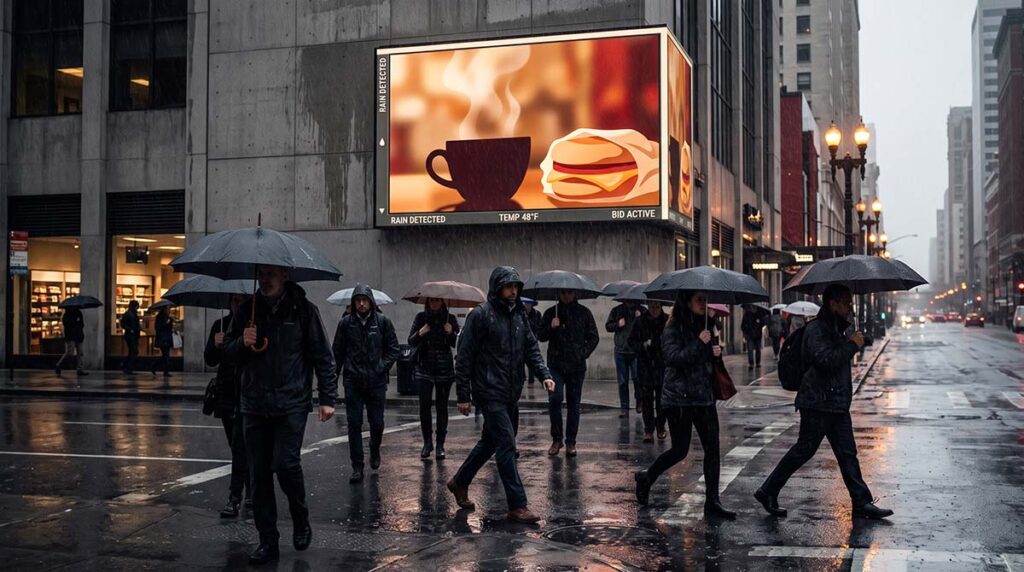
Imagine a restaurant that wants to advertise a hot breakfast sandwich and coffee. In the traditional outdoor model, the brand might buy a morning billboard placement near a commuter route and hope the weather, audience, and appetite align often enough to justify the spend.
In a programmatic DOOH model, the brand can define a more precise rule: show the hot breakfast creative only when the temperature drops below 50 degrees and rain is detected nearby. If those conditions exist, the bid fires automatically. If the temperature rises, the system can stop bidding on the breakfast creative and activate an iced beverage message instead.
The message now follows the lived environment.
This matters because the consumer doesn’t experience advertising in abstraction. They experience it while cold, delayed, hungry, rushed, crowded, overheated, bored, or moving through a specific physical situation. Programmatic DOOH allows the message to respond to those conditions rather than treating them as background noise.
The environment stops being context. It becomes input.
Dynamic Creative Optimization and the Message That Fits the Moment
Winning the bid is only part of the system. The next question is which creative version should appear.
Dynamic Creative Optimization enters at that point. DCO selects the most relevant version of an ad based on the conditions that triggered the opportunity. If the system detects rain and cold, it can serve the warm breakfast creative. If the day becomes hot, it can pivot to cold drinks. If the audience changes, the creative can change with it.
The billboard hasn’t become intelligent in a human sense. The message library has been connected to decision rules. The system doesn’t need to understand the human being in front of the screen as a person. It only needs enough contextual signals to decide which message has the highest probable fit.
That distinction matters. The system doesn’t know you. It knows the conditions around you.
And increasingly, that is enough.
The Mazda Case Study and the Return of Physical Attribution
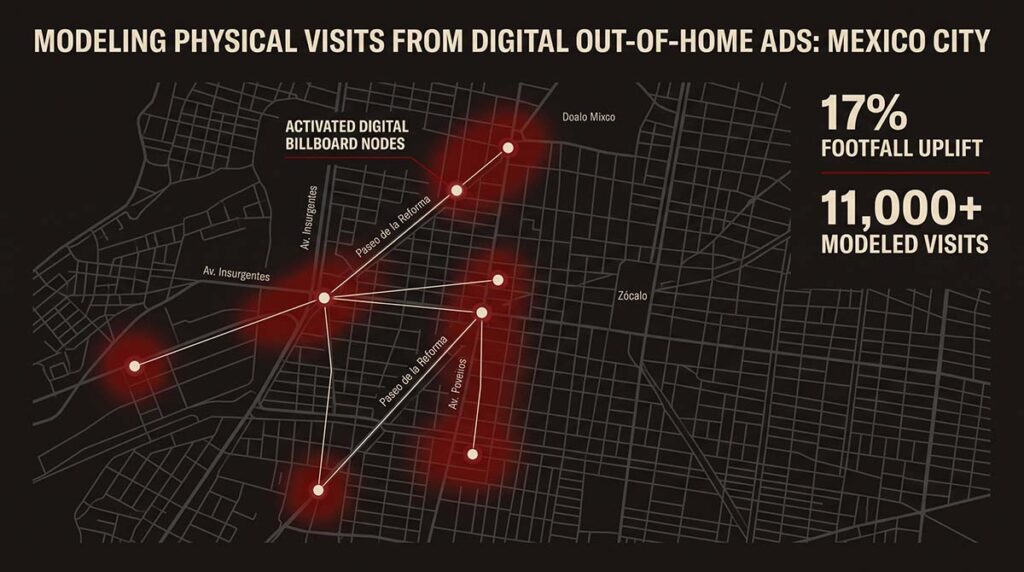
The Mazda CX-70 launch in Mexico City shows why this infrastructure matters at enterprise scale. According to the script, Mazda used JCDecaux’s programmatic platform to connect premium digital screens with live audience data across the city. Rather than simply booking fixed billboard locations, the campaign used logic tied to audience concentration: serve the CX-70 creative during the moments when consumers aged 45 to 64 appeared in the highest concentrations within specific geographic grids.
The screens monitored real-time traffic flow and audience composition. When the target demographic peaked in a given area, the system bid on screen time. When the concentration dropped, the bids paused.
The claimed result was a 17% uplift in physical dealership footfall, with more than 11,000 modeled in-store visits attributed to the algorithm’s bidding decisions.
That proof point matters because outdoor media has historically been harder to attribute than digital channels. A brand could know that a campaign ran, but connecting the physical exposure to physical behavior was more difficult. Programmatic DOOH tries to close that gap by linking screen delivery, audience signals, location data, and modeled offline outcomes.
That’s a precision instrument installed on the side of a building.
The City Is No Longer a Backdrop
When this capability scales across dozens or hundreds of screens, the city itself begins to behave differently as a media environment. Physical media stops functioning as isolated placements and starts behaving like a coordinated digital campaign occupying physical space.
A billboard can synchronize with a social ad. A search campaign can align with a public screen. A retail message can change based on weather, local movement, or audience concentration. The physical and digital layers begin to share the same trigger logic.
That’s why programmatic DOOH belongs inside the broader shift toward omnichannel advertising. It becomes a bridge between the physical visibility of outdoor media and the conditional responsiveness of digital media.
The city is no longer a backdrop. It is a targeting parameter.
That line matters because it reframes the urban environment itself. Streets, stations, intersections, and shopping districts are more than places where people move. They’re increasingly readable environments. The system asks where people are, what conditions are present around them, whether those conditions match the campaign logic, and whether the moment is worth buying.
The Structural Advantage Digital Cannot Recover
Programmatic DOOH is often described in terms of precision, but precision alone is not the most interesting advantage. Digital advertising already has precision. In many contexts, it has more of it.
The more provocative advantage is structural.
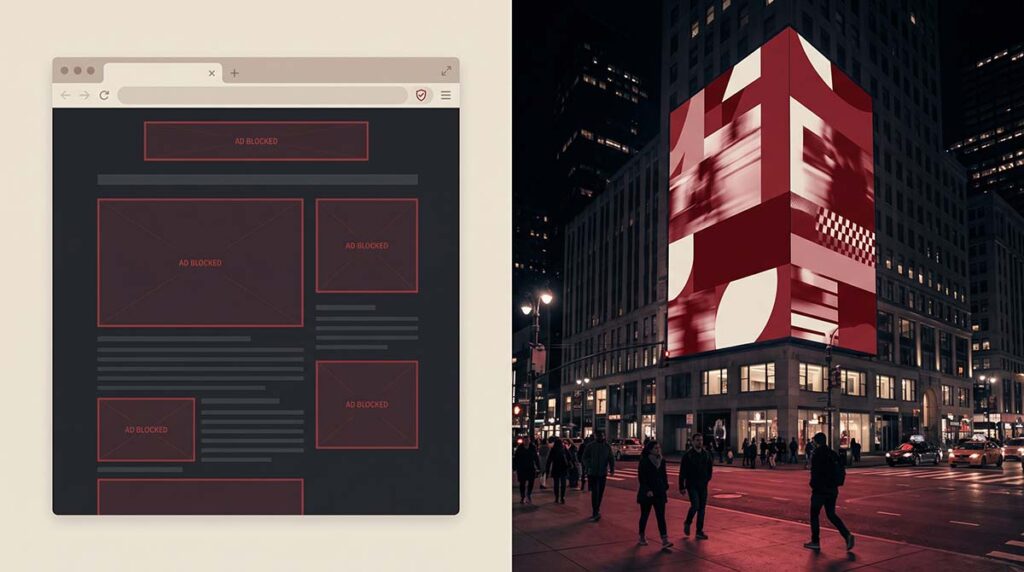
A digital ad on a browser can be blocked. A display impression can be affected by bot traffic. Tracking can be restricted. Cookies can disappear. Platforms can change rules. Users can avoid, skip, close, mute, block, or ignore digital ads through interface-level controls.
A screen on the side of a building cannot be ad-blocked in the same way.
That doesn’t mean every passerby pays attention. Human attention is still limited and selective. But the physical presence itself cannot be removed by the viewer’s browser settings. The screen occupies shared space. The audience can look away, but it cannot make the billboard disappear.
The physical world has no opt-out.
When that unskippable visibility is combined with programmatic buying logic, the result is commercially powerful. Brands can deploy physical media only when conditions meet their parameters while retaining the unavoidable presence of a public screen.
That’s why programmatic DOOH challenges the simple assumption that digital-first channels are always the most efficient or sophisticated. Outdoor media has gained some of digital’s conditional precision while keeping physical media’s environmental force.
From Real Estate to Conditions
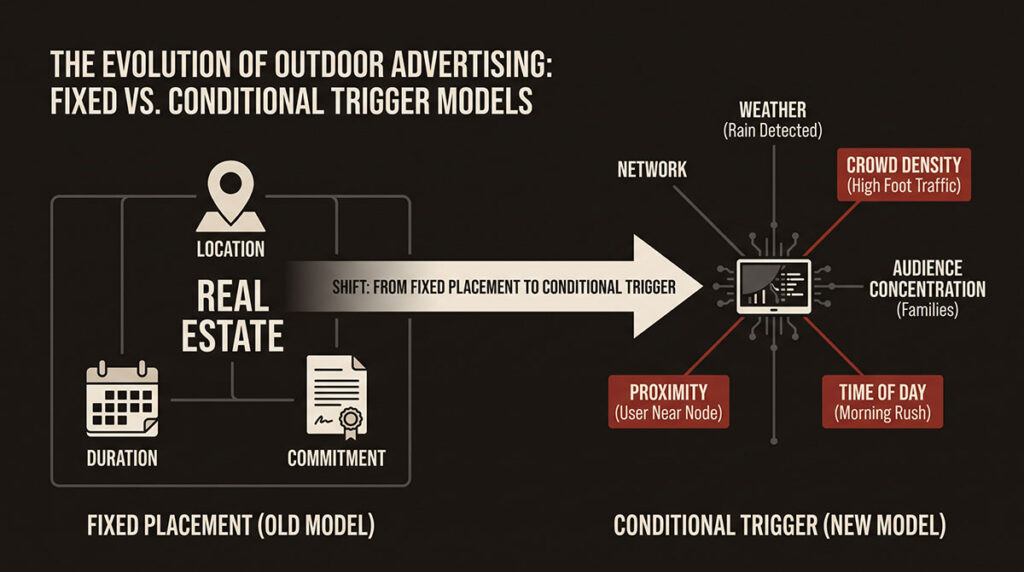
The traditional outdoor buy was fundamentally a real estate transaction. A brand paid for the right to occupy a visible space. The location mattered because it promised traffic, attention, prestige, or proximity.
Programmatic DOOH changes the purchase from geography to condition.
Traffic density, weather, demographic concentration, time of day, proximity to a competitor, local event patterns, and environmental context can all become decision variables. The screen is still physically installed somewhere, but the value of the buy is no longer contained entirely in the location. It is activated by the state of the world around that location.
This changes how marketers think. The question is no longer only where the message should appear. The question is when the world makes the message worth showing.
That is a deeper shift than it first appears. Relevance comes before exposure. The system withholds the message until the conditions justify delivery. The billboard waits for the crowd to become the right crowd.
What This Reveals About People
The subject may be advertising technology, but the deeper subject is human context.
People do not move through the world as stable targets. They move through changing situations. Weather alters receptivity. Crowding alters attention. Delays alter mood. Time of day alters need. Location alters intent. A person standing in the rain outside a transit station is not the same advertising subject as that same person walking through sunshine on a weekend afternoon.
Programmatic DOOH matters because it operationalizes that truth. It treats human behavior as condition-sensitive rather than static. It doesn’t need to know the full interior life of the passerby. It only needs to know enough about the surrounding moment to make a better guess.
That is the quiet psychological insight inside the system: relevance is attached to situation as much as identity.
And once media buying begins to think that way, public space changes. The city becomes a field of conditional opportunities. The billboard becomes a terminal. The advertisement becomes a response
You are not buying space anymore. You are buying the moment.
Frequently Asked Questions
What is programmatic DOOH and how is it different from traditional billboard advertising?
Programmatic DOOH is the automated, data-driven buying and delivery of ads on digital public screens, where placements are triggered by real-world conditions instead of fixed schedules. Traditional outdoor advertising sells exposure in a location for a set duration. Programmatic DOOH sells the moment when a defined set of conditions becomes true.
How does a digital billboard decide which ad to show in real time?
A digital billboard connects to a supply-side platform that makes available screen inventory visible to demand-side platforms. Media buyers set conditional logic inside those buying platforms, such as temperature, crowd density, audience composition, or time of day. When those conditions are present, the bid executes in milliseconds and the matching creative appears.
What is the difference between an SSP and a DSP in programmatic advertising?
A supply-side platform, or SSP, is the marketplace where digital screen owners make their inventory available for automated purchase. A demand-side platform, or DSP, is the system where advertisers define targeting conditions and bid on that inventory in real time. The SSP represents the seller side. The DSP represents the buyer side.
What is Dynamic Creative Optimization in DOOH?
Dynamic Creative Optimization, or DCO, is the system that automatically selects the most relevant version of an ad based on live real-world conditions at the moment of delivery. After a bid is won, DCO chooses the creative variant that best matches the triggering context, such as hot coffee during cold rain or iced drinks on a warm afternoon.
Did the Mazda CX-70 programmatic DOOH campaign drive measurable physical visits?
According to the campaign data referenced in the piece, the Mazda CX-70 launch in Mexico City delivered a 17% uplift in physical dealership footfall, with more than 11,000 modeled in-store visits attributed to the algorithm’s bidding decisions. The campaign targeted moments when consumers aged 45 to 64 appeared in high concentrations within specific geographic grids.
Why is programmatic DOOH considered more durable than digital display advertising?
A digital display ad can be blocked, skipped, muted, restricted by browsers, affected by bot traffic, or avoided through interface-level controls. A physical screen in public space cannot be removed by the viewer’s browser settings. The audience can look away, but it cannot make the billboard disappear.
Isn’t a billboard still a one-to-many medium, no matter how it’s bought?
Physically, yes. A billboard still reaches everyone in its immediate area. The programmatic layer changes the buying logic by filtering when the ad appears. The advertiser is no longer buying every possible passerby. The advertiser is buying the moments when the right conditions exist.
What does it mean to say outdoor advertising shifted from real estate to conditions?
Traditional outdoor media was a real estate transaction. A brand paid for the right to occupy a visible location and assumed that location had value. Programmatic DOOH changes the purchase by making weather, traffic, demographic concentration, timing, and local context the variables that determine whether the bid fires.