
The Theater of the Mind: Why Audio Makes the Listener Do the Work and Why That Works
Audio marketing engagement can exceed visual engagement because audio withholds the finished image and forces the listener to construct it from memory. This sensory gap activates the brain’s prediction machinery through an auditory anchor, cross-modal trigger, hippocampal retrieval, and the default mode network. The resulting narrative transportation occupies cognitive bandwidth, produces measurable physiological arousal, and can reduce persuasion resistance. The listener receives the message by helping create its meaning.
A cast iron skillet hits a 900-degree burner. Steak drops into hot fat, and the crackle arrives before you’ve opened your eyes. By the time you do, your brain has already rendered the meal: the sear marks, the smoke curling off the pan, the color of the fat rendering out.
You built that image yourself. Nobody showed it to you.
That single sensory moment carries the argument. Most marketing operates under the opposite condition. Screens saturate the day so completely that the brain filters most of them out before they register, and the industry’s answer has been to fight noise with more finish.
The Complete Packet Fallacy
Neuroscientists have a term for the standard response to visual saturation. The complete packet describes marketing that pre-renders every visual detail: the lighting, the color palette, even an actor’s microexpressions. Nothing meaningful remains for the viewer to build.
The logic sounds reasonable. When attention is scarce, hand the viewer a finished product and remove the friction of interpretation.
It’s the industry’s most expensive answer to a problem it hasn’t actually diagnosed.
The assumption underneath the complete packet is that higher fidelity produces higher attention. Biology disagrees. A visually complete message asks almost nothing of the brain receiving it, and low effort produces a low-effort audience. Present, but passive.
Engineering the Sensory Gap

Completeness tells the viewer their participation isn’t required. More data delivered with more polish is frequently the weaker move. The stronger one is an intentional sensory gap, a deliberate absence of information that requires the audience to supply the missing piece themselves.
The distinction goes beyond style. It describes how the brain is built to operate.
The Brain as Prediction Engine
Human cognition doesn’t sit still and wait for information. It runs as an active prediction engine, constantly building and updating a working model of the world. The moment a sensory gap opens, the brain rushes to fill it. A missing piece makes an audience lean forward instead of sitting back.
Video can short-circuit that process. It feeds the visual cortex directly, and the transaction may end before imagination is invited in. Audio takes a different route. With no image to lean on, sound moves through the hippocampus and the default mode network, scanning the listener’s memory for something close enough to match.
That route follows a sequence worth naming precisely. An auditory anchor captures attention. The sound sets off a cross-modal trigger, pulling sensory memories from the hippocampus to give it context. The default mode network then uses those memories to generate a bespoke image built from the listener’s own history. The audience becomes a coauthor, whether they notice or not.
Nobody in that chair is receiving a generic commercial. They’re directing a private film, and the studio is their own memory.
The same pathway remains active when the subject shifts from sizzling steak to enterprise complexity.
The GE Experiment
General Electric had acoustic engineering software to sell. The conventional move was obvious: produce a corporate explainer, render every capability, and deliver the message in ninety seconds. GE skipped it.
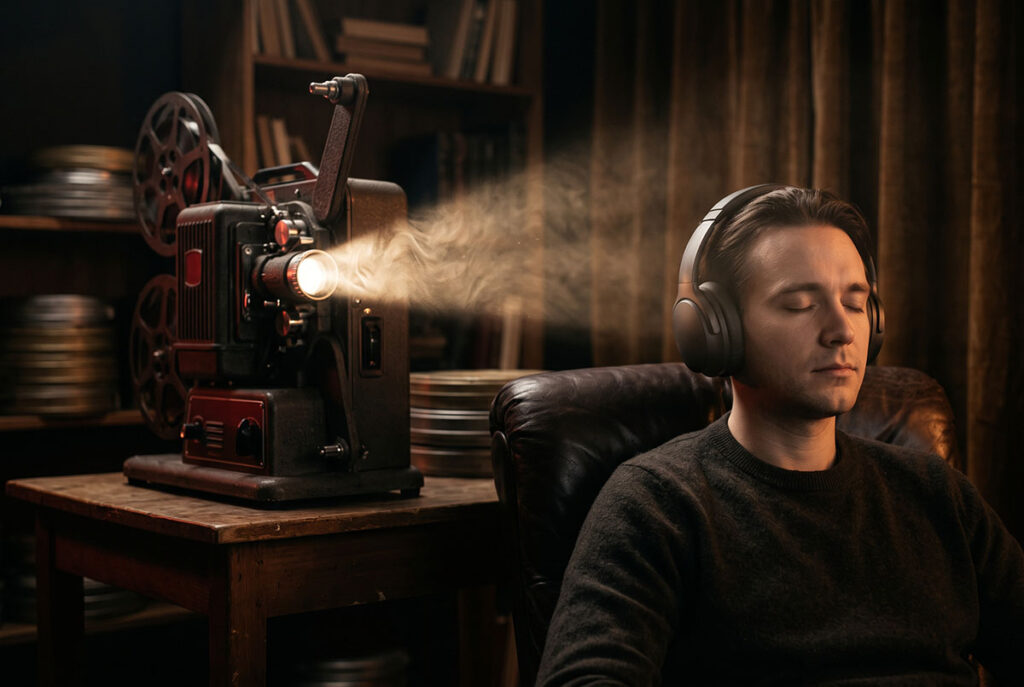
Instead, the company made The Message, a science fiction podcast about a team decoding alien transmissions. Real GE technology sat underneath the fiction, but the format never supplied the finished visual world. That is narrative transportation in practice: cognitive immersion deep enough for the listener to construct the world of the story rather than simply follow its plot.
The audio format forced executives to imagine the subterranean laboratories and work out the strange frequencies as the story unfolded. Every listener built a slightly different version because each one supplied the imagery from a different memory.
That construction work consumes cognitive bandwidth. A brain occupied with building a world has less capacity available for something else.
Skepticism is expensive to run. Give the brain a more demanding job, and it stops paying for the one it was about to hire.
The Biometric Proof
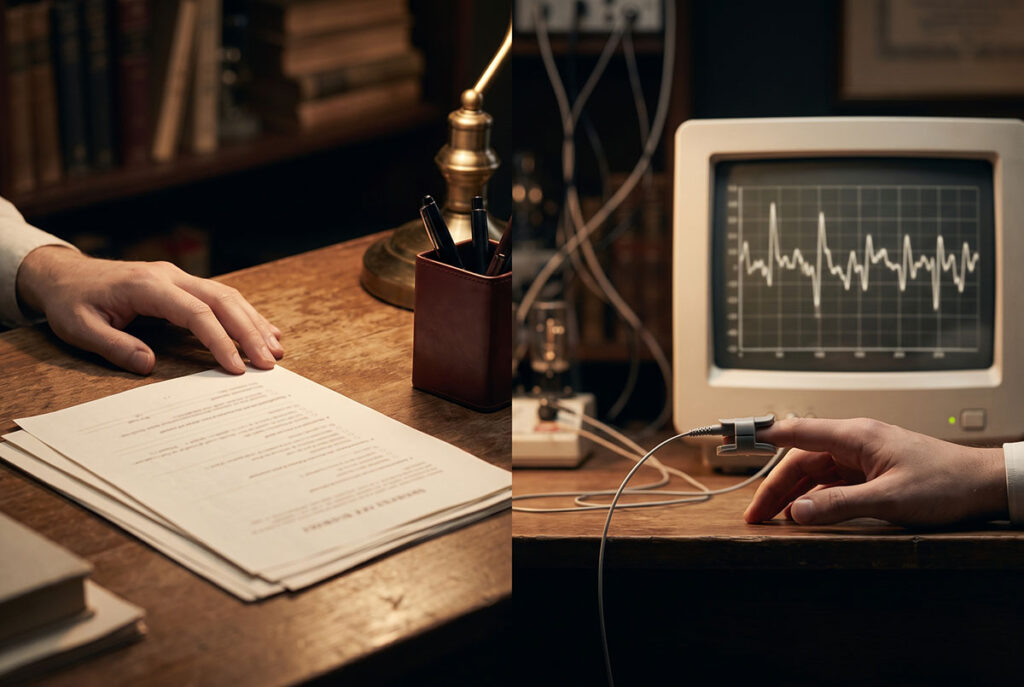
Resistance needs spare cognitive capacity, and a brain constructing a narrative world doesn’t have much left over. Researchers at University College London tested the difference between what people said and what their bodies did. Participants reported that video felt more engaging. Their physiological responses told a different story.
Audio produced significantly higher arousal, measured through heart rate and electrodermal activity.
The conscious mind doesn’t always recognize effort as engagement. The body keeps score anyway, and the body doesn’t lie to a marketing survey.
This gap between self-report and physiological response matters because marketing decisions are often built around what audiences claim to prefer. People can report which format felt smoother, clearer, or more entertaining. Their bodies reveal which one demanded participation.
Effort doesn’t always feel like engagement while it’s happening. Sometimes it feels like imagination.
What the Audience Builds, the Audience Owns
A complete image asks little of the person receiving it. A message with nothing missing gets a passive audience in return.
Audio creates involvement by withholding the image. An auditory anchor begins the process. Memory supplies context. The default mode network turns that material into a private, personally generated picture.
GE demonstrated that the mechanism can work in a B2B environment. The company placed complex acoustic technology inside a science fiction narrative and allowed executives to construct the setting themselves.
The biometric evidence points in the same direction. Audio generated more physiological arousal than video, even while participants insisted that video was more engaging.
The strategic implication reaches beyond podcasts. Any medium can create a productive gap when it withholds the right piece.
A written argument can leave room for the reader to make the final inference. A presentation can introduce evidence before stating the conclusion. A brand story can imply a world larger than the one explicitly shown.
The goal isn’t confusion. The audience still needs enough structure to understand the message and enough specificity to know what matters. The missing element must be deliberate.
Withhold too much and the message collapses. Supply everything and participation disappears.
The Missing Piece Is the Strategy
Marketing budgets still follow the assumption that more is always better: more polish, higher resolution, more rendered detail.
That instinct treats completeness as professionalism. It can also remove the exact mechanism that would have made the audience care.
The strongest communication doesn’t merely arrive in finished form. It recruits the audience into completing it. Memory enters the argument. Imagination gives it shape. Participation turns information into something closer to conviction.
The most persuasive thing you can build may be the one thing you deliberately leave out.
Frequently Asked Questions
Why can audio marketing be more engaging than video?
Audio can create deeper engagement because it doesn’t provide a complete visual picture. The missing image becomes a sensory gap that the listener fills using memory and imagination. That act of construction turns passive reception into active participation and can produce stronger physiological arousal than visually complete media.
What is a complete packet in marketing?
A complete packet is a message that pre-renders every visual detail, including lighting, color, setting, facial expression, and context. It removes interpretive work from the audience. Although this feels polished and efficient, it can lower cognitive participation because the viewer has nothing meaningful left to construct.
What is a sensory gap in audio marketing?
A sensory gap is a deliberate absence of information that requires the audience to supply the missing piece. Audio naturally creates one by providing sound without a corresponding image. The brain responds by retrieving memories, generating context, and constructing a personal mental scene from the incomplete signal.
What does it mean to call the brain an active prediction engine?
The brain operates as an active prediction engine because it continually builds and updates a model of the world. When sensory information is incomplete, it searches for likely explanations and fills the gap. Audio uses this tendency by making listeners generate the image that visual media would normally provide.
What is the cross-modal trigger sequence?
The cross-modal trigger sequence begins when an auditory anchor captures attention. The sound then activates related sensory memories through hippocampal retrieval. Finally, the default mode network uses those memories to construct a bespoke mental image. The listener becomes a coauthor of the experience rather than a passive recipient.
What is narrative transportation?
Narrative transportation is the state of becoming cognitively immersed in a story deeply enough to construct its world mentally. In audio, listeners imagine environments, characters, sounds, and stakes for themselves. This construction occupies cognitive bandwidth and leaves less spare capacity for skepticism or habitual advertising resistance.
How did GE use audio marketing in The Message?
General Electric used the science fiction podcast The Message to place real acoustic engineering technology inside a story about decoding alien transmissions. Instead of showing executives a conventional corporate explainer, the audio format required them to imagine the laboratories, signals, frequencies, and consequences as the narrative unfolded.
Does this mean marketers should replace video with audio?
No. Audio and video serve different communication needs, and a message still needs enough clarity to be understood. The practical lesson is to stop treating completeness as an automatic virtue. Marketers should identify which missing element can recruit memory, imagination, and participation without sacrificing the information the audience needs.