
The Hidden Confidence Tax Behind Every Abandoned Cart
WebAR closes a structural problem digital commerce has tolerated for more than two decades: the imagination gap. Buyers evaluating physical products through flat screens have been forced to estimate scale, simulate fit, and construct spatial reality from photographs. That hidden cognitive tax produces hesitation, cart abandonment, and higher return rates. By running spatial visualization directly inside the mobile browser instead of a downloaded app, WebAR offloads that work to the device and turns the phone into what researchers call a cognitive prosthesis. The result is measurable: roughly 94% higher conversion rates, double the engagement of standard display, and return rates up to 40% lower because the buyer no longer has to imagine what the interface can now confirm.
Every product page on the internet asks the buyer to perform a task that has rarely been acknowledged as work. The buyer has to build a room in their mind, place the product inside it, estimate its scale, imagine its presence, evaluate whether it fits, and then decide whether to risk money on that private simulation.
For more than twenty years, digital commerce has treated this as normal. A few images, a dimension table, a product description, and maybe some customer reviews were assumed to be enough. If the buyer had sufficient information, the logic went, they could make a rational decision.
That assumption hides the real burden. Information is not the same as confirmation. A shopper looking at a sofa, a lamp, a car, a table, a fixture, or any other spatial product is asking a harder question than whether they like it. They’re asking whether they can trust that the object will become real in their environment the way they currently imagine it.
That question is where many purchases stall.
The gap between what the screen shows and what the buyer needs to know is the imagination gap. It’s the cognitive distance between digital representation and physical certainty. Once you see that gap clearly, abandoned carts begin to look different. They’re not always failures of desire. They’re often failures of confidence.
The Product Page Was Never Neutral
A standard product page looks passive. It shows the product. It lists the dimensions. It gives the buyer the information needed to decide.
For spatial products, the product page is also transferring work. The buyer has to mentally rotate the object. They have to estimate scale from photographs that may have been shot under controlled studio conditions. They have to imagine whether the finish matches the room, whether the proportions feel right, whether the product will dominate the space or disappear inside it. The more physical context matters, the more work the buyer must do.
That work creates a cognitive tax. The imagination gap is more than inconvenient. It’s expensive in mental energy. Human beings conserve mental effort, especially when uncertainty and financial risk are present at the same time. When an interface asks the buyer to do too much spatial reasoning before they feel confident enough to act, hesitation becomes rational.
In commerce, hesitation is rarely neutral. It often becomes the decision to leave.
Why Uncertainty Is the Real Friction
Many businesses treat friction as a matter of steps: fewer clicks, faster checkout, shorter forms, cleaner navigation. All of that matters. The deeper friction in high-consideration digital commerce is often uncertainty.
A buyer can tolerate effort if the reward is clear. They can move through a process if the value feels certain. When effort increases while certainty remains low, the internal calculation changes. The buyer begins to protect themselves from risk.
This is where information foraging theory becomes useful. It describes users in digital environments less like perfect rational decision-makers and more like organisms conserving energy while searching for value. The shopper is constantly asking whether the next action is worth the effort required. If the expected value feels high and the effort feels low, they continue. If the effort rises and the certainty doesn’t rise with it, they leave.
That is what happens inside the imagination gap.
The buyer may still like the product. They may still have intent. They may still be close to purchasing. If the interface can’t resolve the uncertainty quickly enough, the buyer’s cognitive budget runs out before the transaction occurs.
This is why high intent isn’t enough. High intent still needs clarity. Without clarity, intent can remain suspended indefinitely.
Early AR Understood the Problem but Failed the Architecture
Augmented reality was the obvious conceptual answer. If the buyer struggles to imagine the product in their space, place the product in their space. Let them see the scale. Let them verify the fit. Let them walk around it. Let the device handle the simulation.
The concept was right.
The early architecture was wrong. Early retail AR often required native applications. A shopper had to leave the buying journey, go to an app store, download an application, wait for installation, approve permissions, and then somehow return to the original shopping context with their intent still intact.
That sequence created a new kind of friction. The technology was supposed to close the imagination gap, but the delivery model opened an adoption gap. The buyer was no longer being asked only to evaluate a product. They were being asked to interrupt their own momentum.
In retail, every additional step is an exit opportunity. A redirect is more than a technical event. It’s a behavioral risk. The moment the buyer leaves the purchase flow, the system has given them a chance to reconsider, delay, become distracted, or abandon.
This is why the app-based model struggled. It asked the buyer to pay another cognitive tax before removing the original one.
WebAR Changes the Decision Environment
WebAR solves the architecture problem by eliminating the interruption. No app. No download. No redirect. The experience runs in the mobile browser, inside the environment the buyer is already using.
That distinction matters. WebAR preserves the buyer’s decision momentum. The shopper taps a link, scans a QR code, or selects a browser-based view-in-your-space option, and the spatial experience begins without forcing them out of the funnel.
This is what frictionless actually means. A slightly smoother version of a broken process still leaves the buyer carrying the work. The real improvement is the removal of the steps that were costing buyers.
Modern WebXR standards allow the browser to access device capabilities like spatial tracking, gyroscopes, and depth sensing. The technical complexity is real, but the buyer doesn’t experience it as complexity. They experience it as confirmation.
That is the deeper shift. WebAR delivers spatial computing without asking the buyer to know spatial computing is happening. The buyer isn’t evaluating a technology. They’re resolving doubt.
The Phone Becomes a Cognitive Prosthesis
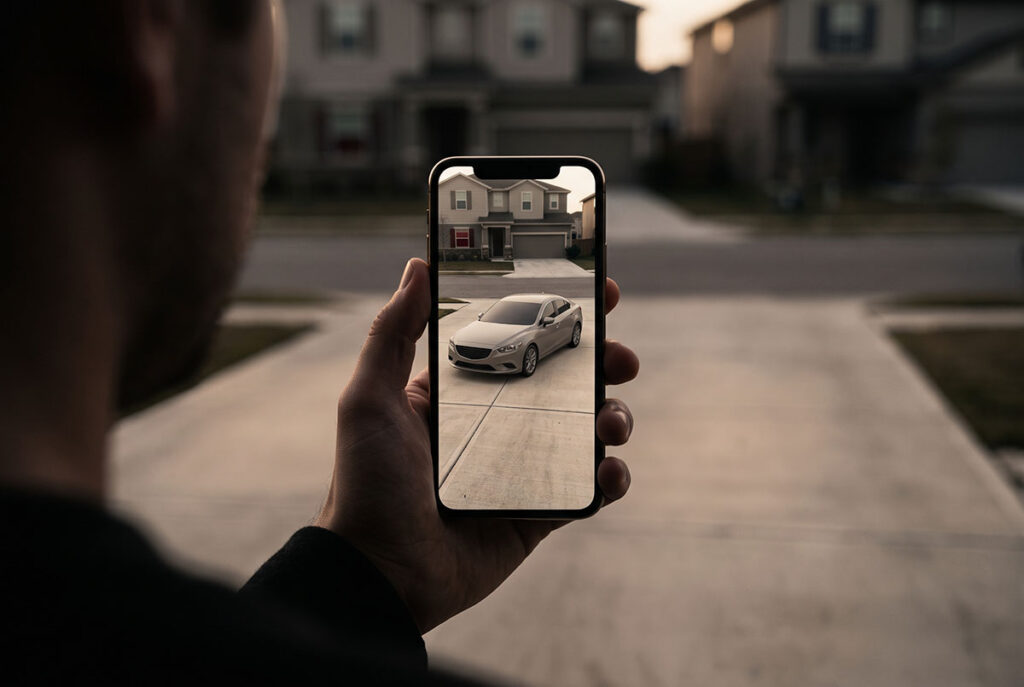
The Toyota Corolla WebAR case is useful because cars are extreme spatial products. A car is expensive, large, physical, identity-laden, and environmentally contextual. The buyer wants to know how it feels in a driveway, whether its scale matches their expectation, and whether the object has the presence they imagined.
That is a lot to ask of a mobile banner ad.
Toyota’s WebAR campaign reduced the entry point to a standard mobile interaction. Tap the ad, grant camera access, and a true-to-scale 3D model of the Corolla appears in the user’s driveway. The user can walk around it, view details, interact with features, and evaluate the vehicle as a spatial object rather than a flat image.
The important point is that the device takes over the spatial calculation. The buyer no longer has to estimate scale. The scale is verified. They no longer have to imagine fit. Fit is demonstrated. They no longer have to hold the product in the mind as an abstraction. It appears in a physical context.
This is why the phrase cognitive prosthesis matters. The phone extends the buyer’s ability to perceive and evaluate reality. It performs the imagination work the buyer previously had to do manually.
WebAR is more than a richer product page. It’s the offloading of a cognitive task that was costing conversions.
The Data Is Really a Behavioral Argument
The performance data matters because it validates the psychology. Products with 3D and AR content have been reported to convert at rates dramatically higher than equivalent products shown through standard 2D imagery. Interactive AR models also generate stronger engagement and click-through behavior than traditional display ads.
The numbers are important, but the mechanism matters more. A major conversion lift is evidence that traditional product pages were managing a structural problem rather than solving it. When the imagination gap closes, doubt decreases. When doubt decreases, the psychological barrier to purchase lowers. The transaction proceeds where it previously stalled.
That is a change in the buyer’s confidence state.
The same logic explains the return-rate impact. When buyers verify fit, scale, and spatial compatibility before purchase, delivery introduces less new information. The product doesn’t arrive as a surprise. It confirms what the buyer already saw.
Returns often happen when reality violates the buyer’s mental model. The product looked smaller, larger, cheaper, brighter, duller, or less compatible than expected. WebAR doesn’t improve the mental model. It replaces part of the mental model with direct visual confirmation.
That distinction is critical. A better photograph still leaves the buyer imagining. A spatial preview reduces the amount of imagination required.
The Imagination Gap Was a Profitability Problem

The imagination gap was never only a UX problem. It was a profitability problem with a UX address.
When buyers hesitate, conversion suffers. When buyers abandon, acquisition costs become less efficient. When buyers receive products that don’t match their imagined reality, returns increase. When returns increase, reverse logistics, margin pressure, and customer dissatisfaction compound.
The front-end uncertainty becomes back-end cost.
This is what makes WebAR strategically important. It changes the economic structure of the decision. More confident buyers complete more transactions. Better-informed buyers return fewer products. The system stops paying for the uncertainty it previously created.
The old model accepted the imagination gap as the cost of selling physical products through flat screens. That cost was never inevitable. It was a design limitation that became normalized because everyone had learned to tolerate it.
The Industry Stopped Asking Buyers to Do Its Work
What WebAR represents is the moment an industry stopped asking buyers to do work it should have been doing itself.
Every abandoned cart has a cognitive story behind it. Someone wanted a product, couldn’t confirm the reality of it, and quietly chose not to risk it. The company may have recorded that as abandonment. The analytics dashboard may have categorized it as funnel leakage. Underneath the metric was a human being facing uncertainty.
The industry called it conversion friction. In many cases, it was closer to a confidence tax levied on every buyer who showed up unprepared to do spatial math.
WebAR matters because it makes that tax visible. It reveals how much effort standard product pages were asking buyers to absorb. It shows that the problem was not always persuasion, pricing, or product desirability. Sometimes the problem was that the buyer had reached the limit of what they were willing to imagine.
Once a competitor closes that gap in a category, the old product page starts to look different. Structurally incomplete.
The buyer no longer has to build the room in their mind. The product can simply enter the room.
Frequently Asked Questions
What is the imagination gap in ecommerce?
The imagination gap is the cognitive distance between a product’s digital representation and the buyer’s ability to evaluate it as a physical object in their actual environment. For spatial products like furniture, fixtures, or vehicles, buyers have to mentally construct scale, fit, and presence from photographs and dimension tables. The product page gives them information, but it still leaves them doing the confirmation work.
How does WebAR increase conversion rates?
WebAR increases conversion by removing the cognitive work that produces hesitation. Products with 3D and AR content have been reported to convert at rates roughly 94% higher than equivalent products shown through standard 2D imagery. The mechanism is doubt reduction. When buyers can verify scale and fit directly in their environment, the psychological barrier to purchase lowers.
What is information foraging theory, and how does it apply to online shopping?
Information foraging theory treats users in digital environments less like perfect rational decision-makers and more like organisms conserving energy while searching for value. Applied to ecommerce, it means buyers constantly weigh expected reward against perceived cognitive effort. When effort rises faster than certainty, they leave, even when their original intent was strong.
Why did early AR fail in retail?
Early retail AR often required native applications. Shoppers had to leave the buying flow, navigate to an app store, download an application, grant permissions, and then return with intent still intact. That sequence created app fatigue. The technology addressed the visualization problem, but the architecture introduced new friction at the worst possible moment.
What does it mean for a phone to be a cognitive prosthesis?
A cognitive prosthesis extends a person’s ability to perceive, evaluate, or process reality. In WebAR, the phone becomes a cognitive prosthesis because it takes over spatial calculation the buyer would otherwise perform internally. Scale is verified rather than estimated. Fit is demonstrated rather than imagined. The device performs the imagination work.
How much can WebAR reduce product return rates?
Brands using WebAR report return rates up to 40% lower than those relying on traditional product imagery. The reason is structural: buyers have already verified fit and spatial compatibility before the product ships. Delivery confirms what the buyer already saw instead of introducing a negative surprise.
Is WebAR worth implementing for businesses with smaller catalogs or non-spatial products?
WebAR’s value increases when the product’s scale, fit, and physical context affect the buying decision. For furniture, vehicles, fixtures, large electronics, and home goods, the imagination gap is structural and the return on investment can be direct. For products where spatial fit barely matters, the cognitive tax is lower and the lift will likely be smaller.
What is the practical takeaway for ecommerce businesses?
Treat abandoned carts as evidence of uncertainty before treating them as evidence of weak intent. For spatial products, the buyer may want the item but still be unable to confirm how it will exist in their environment. WebAR matters because it makes that confidence tax visible, and once a competitor closes the gap in a category, the standard product page starts to look structurally incomplete.