
The Real Decision Happens Before Your First Sales Conversation
The B2B buying decision often forms before the first sales conversation, inside a dark funnel of AI-assisted research, private peer validation, technical documentation, and internal risk review. By the time a buyer requests a demo, the buying committee may already have assembled an AI shortlist, tested it through dark social, and selected the vendor most capable of surviving every internal objection. The visible sales process increasingly functions as validation, negotiation, and vendor theater. Vendors that fail to earn the day-one advantage upstream are often competing for a decision that has already been made.
A jury files back into the courtroom. Twelve people take their seats, and every eye in the room turns toward them as though the deciding is happening now. The decision happened hours earlier, in a locked room, over evidence the gallery never saw and arguments the gallery never heard. The courtroom is about to witness a reading.
Marketing and sales organizations have spent decades treating the demo request as the moment a decision begins. A prospect lands on a website, enters a corporate email, and clicks “Request Demo.” The entire revenue apparatus wakes up. Account executives get dispatched. Discovery calls get scheduled. Everyone behaves as though the buyer has arrived with an open mind, ready to be educated and persuaded.
The form fill is a courtroom reading of a verdict reached weeks earlier, in a room the vendor was never invited into.
The old model of B2B buying moved from awareness to consideration to decision on a timeline the seller could shape. That sequence still exists in CRM dashboards and marketing attribution models. It no longer matches how enterprise software gets purchased. A sales team that treats the demo click as the opening move is racing an opponent that already crossed the finish line.
The Committee Built to Say No
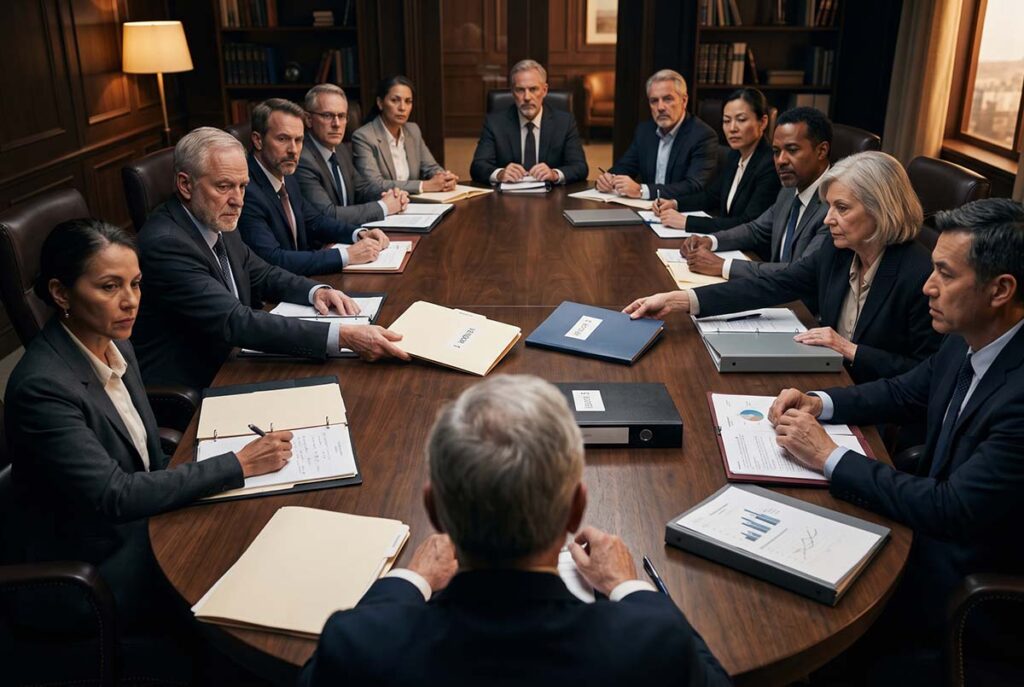
A 500-person software company needs a customer relationship management system capable of running operations globally. Once licensing and implementation costs are counted, the purchase is worth roughly a million dollars. Ten years ago, a decision like that needed five signatures. By 2026, it needs thirteen.
Thirteen stakeholders sounds like consensus-building. In practice, it functions closer to gridlock. Eighty-six percent of these deals stall somewhere in the process, and sixty percent of stalled deals end with no vendor chosen. The organization refuses to choose anyone.
A thirteen-person buying committee is built to survive the worst possible mistake.
Every person at that table is protecting against a specific, personal failure. The CIO fears an integration that breaks under load. The CMO fears deploying a tool nobody adopts. The CFO fears a contract that quietly balloons in year two.
The committee’s real function is elimination. It rules out every option that could get one of its members fired.
That changes what winning means for the vendor. The committee is asking which choice can survive every internal objection with the least political exposure. The strongest presentation matters less than the safest decision the organization can defend later.
Going Dark

The committee leaves the vendor’s website almost entirely. Enterprise buyers actively avoid gated whitepapers, tracked advertising links, and anything that feels watched. They want room to think before a sales representative starts shaping the conversation.
Refuse the tracking and the trail disappears. Most of the research that determines a million-dollar purchase leaves no usable data behind.
Picture the buyer’s journey as an iceberg. The visible portion above the waterline contains the clicks, tracked visits, and form fills a marketing dashboard can see. Beneath it sits the much larger body of evaluation: anonymous review reading, private conversation, and word of mouth that never touches a vendor’s domain.
That submerged portion is the dark funnel, where much of the deal gets decided.
Inside it, buyers rely heavily on dark social: private, peer-to-peer conversation in closed Slack communities, private forums, and direct messages. These exchanges are invisible to any platform the vendor can monitor.
No lead-scoring model measures this activity because the conversations were designed to remain private.
By the time a marketing dashboard lights up, it’s watching the aftermath.
The AI Shortlist
Lead scoring becomes far less useful when the first meaningful filter happens somewhere it can’t observe. Return to the 500-person software company and its million-dollar CRM decision.
The VP of Sales Operations opens a secure enterprise AI model and asks it to surface hidden integration costs across the CRM market. Within seconds, the model returns a shortlist: Salesforce, Zoho, and HubSpot.
No sales representative has spoken to anyone. No vendor knows a decision is underway.
Ninety-four percent of enterprise decision-makers now use AI somewhere in the buying process, often to assemble an initial shortlist before running a traditional search.
The AI replaced the moment when a salesperson used to get a say.
That shift changes the competitive field before the formal process begins. Brands with clear positioning, credible technical documentation, and a strong reputation are easier for an AI system to retrieve and recommend. Brands without those signals may never appear in the first comparison.
Their sales teams can’t influence a decision they were never invited to join.
Consensus Without a Vendor in the Room
With the shortlist set, the committee splits up to stress-test it. Members conduct their research separately and mostly outside any vendor-controlled environment.
The CMO skips Google and posts a question inside an invite-only Slack community of marketing peers: What does implementation actually look like after the contract is signed?
At the same time, the CIO quietly audits each vendor’s API documentation and security posture without triggering a tracking pixel.
None of this appears in a CRM. All of it shapes the outcome.
The committee weighs Salesforce’s scale against Zoho’s price and HubSpot’s speed to deploy. This company values getting live quickly over getting every possible feature, so HubSpot becomes the low-risk, defensible choice.
The decision is finished before anyone books a call. The organization simply hasn’t announced it yet.
Then someone clicks “Request Demo.”
The click publicly confirms an evaluation that has already ended.
The Math of Arriving Late
Sixty-one percent of the buying journey happens before a vendor makes first contact. During that selection phase, the committee builds consensus entirely out of view.
The remaining thirty-nine percent contains the demos, proposals, and pitch decks. It looks like a sales process but often functions closer to vendor theater.
By this stage, buyers are confirming a decision they already made. The vendor that appeared on the AI-generated day-one shortlist wins the deal ninety-five percent of the time.
Everyone arriving later fights over the remaining five percent. Those vendors are also thirty-one percent more likely to get dragged into a price war.
This is the day-one advantage. The first credible shortlist becomes the frame through which every later option is judged. A late entrant must overcome an established preference while proving that the committee’s earlier work was incomplete.
Showing up late costs more than the deal. It costs the right to compete on anything but price.
The Leverage Moved Upstream
You can run a flawless sales process, deliver a perfect demo, and still lose a deal you were never truly competing for because the competition ended before you knew it started.
Demos and discovery calls still matter. Their role has changed. They validate capability, answer final objections, and reduce the remaining risk around a preference formed earlier.
The leverage now sits upstream in technical documentation a buyer reads alone, peer conversations a vendor never sees, and an AI shortlist assembled before anyone picks up a phone.
A brand that first appears at the form fill arrives for the reading of a verdict it had no part in reaching.
The central sales question has changed. Closing better won’t solve an upstream absence. The real issue is whether your brand exists anywhere in the private environment where the decision gets made.
That’s where the contest now begins.
Frequently Asked Questions
Does the real B2B buying decision happen before the first sales conversation?
In many enterprise purchases, the buying committee forms a strong preference before contacting a vendor. Members use AI research, peer recommendations, reviews, technical documentation, and internal evaluation criteria to narrow the field. The first sales conversation often validates an existing preference instead of beginning an open evaluation.
What is the dark funnel in B2B marketing?
The dark funnel is the untracked portion of the buyer journey where research and evaluation happen outside vendor-controlled environments. It includes anonymous review reading, private conversations, AI-assisted research, technical documentation, and internal debate. These activities leave little digital evidence, so conventional attribution and lead-scoring systems rarely capture them.
What is dark social in a B2B buying process?
Dark social refers to private, peer-to-peer conversations that influence buying decisions but can’t be observed through standard analytics. These exchanges happen in closed Slack groups, direct messages, private forums, executive communities, and personal conversations. Buyers use them to obtain candid implementation stories and reputation signals that vendor content can’t provide.
What is an AI shortlist?
An AI shortlist is the initial group of vendors produced when a buyer asks an AI system to compare options, identify risks, or recommend solutions within a category. The answer may draw from documentation, reviews, technical content, and existing reputation. Vendors omitted from this first filter may never enter the formal evaluation.
What is the day-one advantage in enterprise sales?
The day-one advantage belongs to vendors included in the buyer’s initial shortlist before formal sales contact begins. Those brands become the reference points against which later options are judged. A late entrant must overcome an established preference and is more likely to compete through discounts instead of differentiation, trust, or strategic fit.
Why are modern B2B buying committees so difficult to persuade?
Each member of a large buying committee protects the organization and their own career from a different failure mode, including integration, adoption, compliance, budget, procurement, and political risk. The winning vendor is often the option that can survive every objection with the least internal exposure.
Is the sales demo still important if buyers have already formed a preference?
The demo still matters, but its role has changed. It often confirms product capability, answers final objections, supports negotiation, and reduces perceived risk.