

The Gap Between Seeing and Doing
Physical advertising can generate consumer intent. The failure usually happens in the infrastructure between attention and action: the physical-to-digital gap, where a person who wants to act has to manually bridge two worlds using effort the campaign never accounted for. Cognitive friction compounds across the journey from seeing to doing, and behavioral economics shows that any operational delay creates a window for the brain to reconsider. NFC-embedded print closes that gap mechanically by replacing the consumer’s bridging sequence with a single physical gesture that lets the smartphone execute a digital action directly.
Physical advertising can create intent in the real world, but it often can’t carry that intent anywhere useful. A person sees a poster. They notice a retail display. They pick up a package. They pause in front of a sign. Something in the message works. Attention becomes interest. Interest becomes the beginning of action. Then the system asks the person to work.
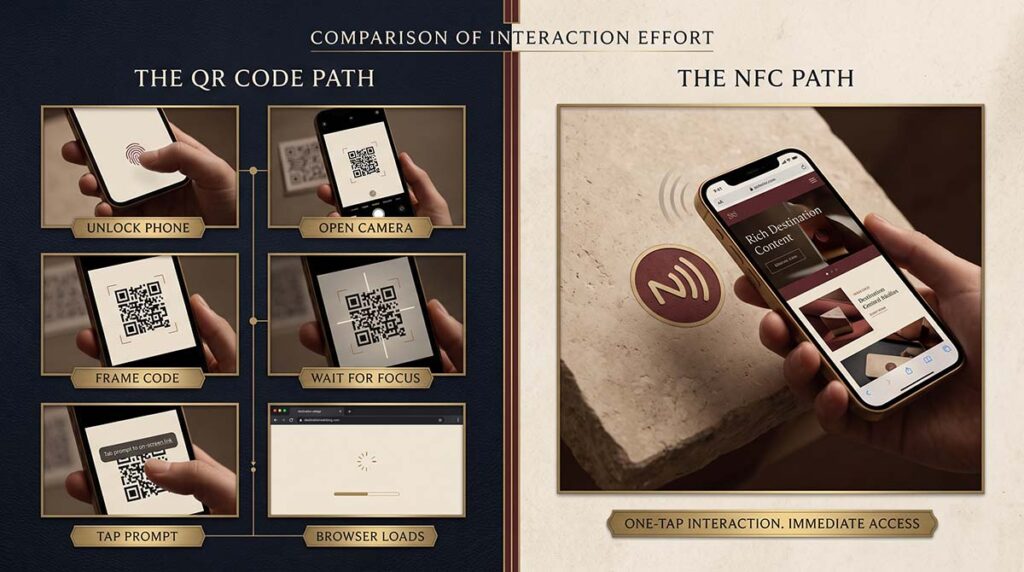
Take out the phone. Unlock it. Open the browser. Type the address. Fight autocorrect. Search for the brand. Find the correct result. Wait for the page to load. Or scan the QR code. Open the camera. Frame the square. Avoid glare. Wait for focus. Tap the notification. Then wait again.
Each step seems minor on its own. None of them feels like a catastrophic design failure. But behavior rarely collapses because of one dramatic obstacle. More often, it dissolves through accumulated resistance.
The person was interested. The system made interest feel like work. Print, packaging, and out-of-home media can generate intent. The weakness appears when the infrastructure around them fails at the exact moment intent needs to become action.
The gap between seeing and doing is an infrastructure failure.
Intent Is Fragile

Marketing often treats intent as stable. Once someone wants something, the assumption is that desire will last long enough for the person to complete the required steps. Attention doesn’t behave that way.
Intent has a half-life. It decays when the path becomes unclear. It weakens when the next step requires effort. It becomes vulnerable the moment the person has to shift from feeling to operating.
Cognitive friction names that resistance. It’s the burden created by small required actions that stand between a person and their goal. It isn’t the same as confusion, although confusion can be part of it. It’s the total weight of having to manage a sequence the person didn’t come there to perform.
A person who sees a poster isn’t trying to become a navigator. They aren’t trying to become a search operator. They’re trying to act on a moment of interest. When the system makes them perform the bridge themselves, the campaign starts taxing the intent it just created.
That tax is easy to underestimate because the individual actions look trivial. Unlocking a phone is trivial. Opening a browser is trivial. Typing a URL is trivial. Searching is trivial. Waiting for a page to load is trivial. Together, those steps become a behavioral filter.
Friction becomes attrition.
The Pain of Paying Extends Beyond Money
Behavioral economics gives us another way to understand this failure. The pain of paying describes the psychological discomfort associated with parting with money, but the underlying mechanism extends beyond price. Any delay or operational burden between wanting something and getting it creates a window for reconsideration.
That window is dangerous. The brain isn’t neutral during delay. It reassesses. It wonders whether the action is worth continuing. It notices competing demands. It compares the effort to the expected reward. It becomes aware of itself acting, and that awareness changes the decision.
Most campaigns don’t fail because the consumer didn’t want the product. They fail because the architecture made wanting it feel like work.
That distinction matters. A campaign that fails because people don’t want the offer needs better positioning, better creative, better targeting, or a stronger product. A campaign that fails because the path from interest to action is structurally weak has a different problem. The failure sits in the transition.
The consumer did their part. The campaign created intent. The system failed to protect it.
QR Codes Improved the Bridge Without Finishing It
QR codes were a real improvement. Before they became widely normalized, print often had no practical bridge into digital action. A poster could show a URL. A package could direct people to a website. A magazine ad could include a campaign address. The consumer still had to manually carry the message from the physical world into the digital one.
QR codes gave print a hyperlink. That mattered.
A hyperlink still isn’t the same as a frictionless connection. That distinction gets lost. QR codes solved the visibility problem, but they didn’t fully solve the operational problem. The consumer still has to perform a sequence. They take out the phone, unlock it, open the camera, frame the code, hold steady, deal with glare, wait for recognition, tap the notification, and let the browser open.
When everything works, it feels acceptable. When anything fails, the weakness becomes obvious.
A glossy surface reflects light. The camera hesitates. The code is too small. The angle is awkward. The person is moving. The notification disappears. The browser opens slowly. The landing page loads badly. Each small imperfection adds a little more time for intent to fade.
QR codes repackaged the bridging problem in a smaller box. That diagnosis doesn’t dismiss QR codes. It clarifies their role. They reduced one kind of friction while preserving another. They made print scannable, but the consumer still had to operate the bridge.
NFC Moves the Work Into the Object
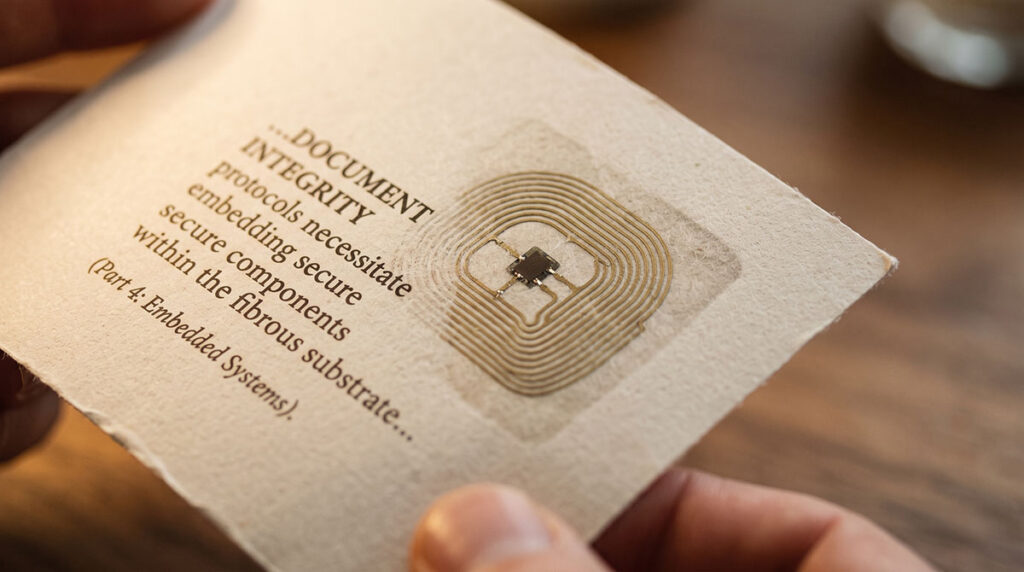
NFC-enabled print changes the problem because it moves the work out of the consumer’s behavioral sequence and into the physical infrastructure itself.
Near field communication allows a printed object to contain a passive chip and antenna embedded inside the material. The user brings a phone within a few centimeters of the surface. The phone’s electromagnetic field induces a tiny current in the embedded antenna. That current wakes the dormant circuit just long enough for it to transmit its encoded payload back to the phone.
The chip doesn’t need a battery. It doesn’t need to remain active. It borrows power from the phone for the brief moment it needs to communicate, then returns to dormancy.
The mechanism has a strange elegance. The physical object isn’t glowing, moving, speaking, or asking for attention. From the outside, it still looks like print. Beneath the surface, it has become capable of action.
The poster stops being a picture of an offer. It becomes the portal.
That’s the architectural shift. NFC changes who performs the bridge. The consumer no longer has to manually connect physical exposure to digital action. The object does the bridging.
The distinction between QR and NFC is more than technical. QR requires optical interpretation and user-managed framing. NFC relies on proximity and magnetic induction. QR asks the camera to see. NFC asks the phone to touch.
The physics don’t require visibility. Smudges, glare, dim light, and surface reflection matter far less because the interaction doesn’t depend on line-of-sight optics. The user doesn’t need to aim at a symbol. They only need to bring the phone close enough for the system to complete the handshake.
The experience feels immediate because the human sequence has been removed.
The Tap Is a Different Kind of Signal
The proximity requirement of NFC might look like a limitation at first. The user has to be physically close. They have to bring the phone toward the surface. They have to tap or nearly tap the object. That requirement gives the interaction its behavioral clarity.
To tap a poster, a package, or a product label, the person has to mean it. They aren’t passively scrolling. They aren’t being invisibly tracked across a feed. They aren’t accidentally triggering an impression. They’re making a physical gesture toward an object in the real world.
That makes the resulting data different. It’s closer to declared intent than inferred behavior. In marketing terms, this connects to zero-party data: information a person knowingly and voluntarily provides rather than data inferred through observation.
The tap is the consent form no one had to read.
That line works because it compresses the psychological difference. A tap is a behavioral declaration. The person closes the distance. The system responds.
In an environment where tracking has become more contested and passive data has become less trusted, explicit gestures matter. They aren’t morally pure by default. They’re structurally clearer. The person acted. The system knows why.
The data is cleaner because the behavior is cleaner.
Physical Media Becomes Executable Infrastructure

NFC doesn’t make print more decorative, more interactive, or more modern in a superficial way. It changes the category.
Print becomes executable infrastructure.
That phrase matters because it prevents the argument from collapsing into novelty. The point isn’t to make posters “smart” for the sake of sounding futuristic. The point is to change what a physical object can do inside a behavioral system.
A traditional poster creates exposure. A QR-enabled poster creates a visible bridge. An NFC-enabled poster can trigger an action.
That action might open a universal link. It might launch a payment gateway. It might add an item to a cart. It might start an augmented reality experience. It might retrieve provenance information, product details, or dynamic pricing. The use case will vary, but the structural shift remains the same.
The print executes the digital experience. Once that becomes visible, physical media looks different. Packaging becomes a gateway. Retail shelves become interfaces. Posters become action surfaces. Magazine pages become portals. Product labels become data nodes. Out-of-home advertising becomes less like a message and more like a distributed layer of physical access points.
Every printed surface doesn’t need NFC. That would be the wrong lesson. The stronger point is that any campaign depending on immediate action has to account for the transition between attention and behavior.
A weak transition leaks.
Retail Shows the Full System

The Casino supermarket example moves the argument out of theory. When a physical product on a shelf contains an embedded NFC tag, the shopping trip changes.
A customer can tap the product and retrieve information instantly. Origin, pricing, media, context, and purchase options can appear without requiring the customer to search. When the system integrates with the retailer’s app, the item can move directly into a digital cart. Checkout can happen from the aisle.
The significance goes beyond convenience. The system removes an entire bottleneck.
Checkout lines are one of the most familiar forms of physical retail friction. They’re so normalized that people often stop seeing them as system failures. From a behavioral perspective, the checkout line is a delay inserted between selection and completion. It creates another window for abandonment, frustration, reconsideration, or reduced satisfaction.
NFC-enabled retail doesn’t simply make the line faster. In the right architecture, it makes the line unnecessary for the portion of customers using the system.
That’s what it means to remove friction as a category rather than improve it. The same logic applies beyond grocery. Museums, events, luxury retail, healthcare materials, direct mail, trade shows, packaging, outdoor advertising, campus communication, and product education all face some version of the physical-to-digital gap.
The question is whether the system makes the person carry the bridge.
The Best Creative Still Needs a Path
Creative excellence doesn’t automatically protect intent.
A print campaign can be beautifully designed, strategically positioned, emotionally intelligent, and perfectly placed. It can generate the right feeling in the right person at the right moment. A clumsy next action still makes the campaign vulnerable.
That’s uncomfortable because it relocates part of the failure. The leak may sit in the mechanics rather than the message.
Creative still matters. The system around creative matters more than marketers often admit. The message creates the impulse. The infrastructure determines whether the impulse survives contact with action.
The best-performing print campaign of the next decade may not be the one with the sharpest creative. It may be the one that understood what happens the second someone tries to act on it.
That’s the deeper lesson of NFC-enabled print. The subject isn’t really a chip in paper. The subject is the cost of asking humans to preserve intent across unnecessary steps.
Every system makes a claim about human behavior. A QR code assumes the user will tolerate a small operational task. A URL assumes they will manually search. A traditional poster assumes awareness is enough. NFC assumes intent should be captured at the moment it appears.
That assumption may prove much closer to how people actually behave.
The Infrastructure of Wanting
Physical advertising has always been capable of making people want things. The failure has been what happened next.
For decades, the industry has designed around the physical-to-digital gap rather than through it. It has accepted the transition as a natural inconvenience. It has treated the user’s extra effort as normal. It has assumed that enough motivation will overcome the system’s small obstacles.
The small obstacles were never neutral. They were part of the funnel. They were part of the conversion rate. They were part of the customer experience. They were part of the trust environment. They were part of the campaign’s real performance.
NFC-enabled print makes that visible because it shows what happens when the bridge is no longer outsourced to the consumer. The gesture becomes simpler. The data becomes cleaner. The experience becomes faster. The physical object becomes more capable.
The deeper reframe is simple: physical media has never been limited by the fact that it’s physical. It has been limited by what happened the moment someone tried to act on it.
Once you see that, you start noticing the same pattern everywhere. Interest doesn’t disappear randomly. It gets interrupted. Desire doesn’t fail in isolation. It gets taxed. Trust doesn’t always collapse dramatically. Sometimes it erodes through tiny demands the system never had to make.
The gap between seeing and doing is where many campaigns quietly lose the person they already persuaded.
NFC matters because it closes that gap mechanically. The larger lesson lasts longer: when you want people to act, stop making them carry the infrastructure of action themselves.
Frequently Asked Questions
What is the physical-to-digital gap in marketing, and why does it matter?
The physical-to-digital gap is the moment when a consumer has to move manually from seeing a physical advertisement to completing a digital action. It matters because intent is fragile. Every step between seeing and doing creates room for hesitation, distraction, or abandonment. The gap is a failure in marketing infrastructure.
What is cognitive friction, and how does it affect marketing conversion?
Cognitive friction is the resistance created by small required actions that stand between a person and their goal. In marketing, it describes the burden of unlocking a phone, opening a browser, typing a URL, and navigating search results. Each step may seem minor, but together they become a behavioral filter that weakens conversion.
What did Drazen Prelec mean by “the pain of paying,” and how does it apply to advertising?
Prelec’s pain of paying describes the discomfort and hesitation that can appear during the act of payment or decision completion. In advertising, the same mechanism appears when operational effort sits between intent and action. Price isn’t the only source of hesitation. Delay can create it too.
How does NFC work when embedded in print materials?
NFC-enabled print contains a small passive chip and antenna embedded inside the material. When a phone comes within a few centimeters, the phone’s electromagnetic field induces a tiny current in the antenna through energy harvesting. That current briefly wakes the chip so it can transmit its encoded payload to the phone.
What is zero-party data, and why does NFC generate it?
Zero-party data is information a person knowingly and voluntarily provides. NFC can generate it because tapping requires deliberate proximity. The person walks toward the surface, raises the phone, and closes the distance. That physical gesture creates a clearer signal than passive behavioral tracking.
Why didn’t QR codes solve the physical-to-digital gap?
QR codes gave print a hyperlink, which was a real improvement. They still preserved an operational sequence. The consumer has to unlock the phone, open the camera, frame the code, deal with glare, wait for focus, tap a notification, and wait for the browser. QR codes reduced one form of friction while leaving the consumer responsible for the bridge.
What does NFC-enabled print do differently at a technical level?
The smartphone can intercept the NFC payload at the operating-system level before a browser or app has to be opened manually. That means a tap can launch a payment gateway, augmented reality environment, universal link, or cart action without making the user manage a visible sequence of steps.
Is NFC-embedded print already deployed commercially, or is this theoretical?
It has already been deployed commercially. Casino, the French supermarket chain, embedded NFC tags in products on its retail floor so customers could retrieve product information and add items to a digital cart from the aisle. For customers using the system, the checkout line effectively disappeared.