

How Answer Engines Replaced Discovery With Editorial Judgment
Answer engines change brand visibility by replacing open discovery with algorithmic synthesis. Instead of giving buyers a list of options to evaluate, systems like ChatGPT and Google AI Overviews retrieve information, compress it, and deliver a framed conclusion that can include or exclude a brand before the buyer ever reaches its website. That shift makes external corroboration, machine readability, tone flattening, representation evaluation, and zero-click discovery central to modern brand strategy. The visibility problem now turns on whether machines can verify a brand well enough to represent it.
For about twenty years, the internet worked like a very large library.
You entered a query, and the search engine pointed you toward shelves. Some shelves were more prominent than others. Some were closer to the front. Some were easier to reach. The structure still made sense. You searched. You opened tabs. You compared claims. You evaluated competing sources. You decided which brands deserved trust.
Search rankings were always shaped by incentives, technical systems, authority signals, advertising pressure, and platform logic. The internet was never neutral. But the buyer still occupied an active role in the discovery process. Search returned options. The human performed the synthesis.
That active role is shrinking.
The shift from search engines to answer engines is more than a change in interface. Blue links becoming conversational responses is the visible part. The deeper change is a transfer of judgment. The system no longer points the user toward the market. It interprets the market and returns a conclusion.
That is why the change feels so convenient. It removes friction. It spares the buyer from opening twelve tabs, triangulating reviews, comparing vendor pages, and deciding which sources deserve credibility. The buyer asks, and the system answers.
Convenience always carries a cost. Every act of simplification requires an act of exclusion. Every clean answer is built from decisions about what mattered, what did not, which sources were credible, which claims were unsupported, and which alternatives deserved to appear at all.
The shortcut feels like clarity. That is the problem.
From Search Results to Machine Verdicts

Traditional search was built around indexation. A brand needed to be discoverable, crawlable, relevant, and authoritative enough to appear near the top of a results page. That was the contest. Get found by the librarian. Secure a visible shelf. Give the buyer a reason to click.
The buyer still had work to do. That work could be annoying, but it also preserved agency. A user could open five different sources, compare the language, detect exaggeration, notice contradictions, and decide which vendor seemed credible.
Answer engines compress that process. They retrieve information from across the web, feed it through a model, and synthesize the result into a single response. The user receives a guided interpretation of the territory.
That distinction matters because the answer carries the tone of authority. It arrives cleanly formatted, fluently phrased, and often accompanied by citations or source references. It feels less like a list of possibilities and more like the judgment of a competent advisor.
Search engines returned results. Answer engines return verdicts. A verdict is information after judgment has been applied.
The Librarian Became the Editor

The librarian helps you locate materials so you can perform your own interpretation. The editor reviews the available material, decides what belongs, removes what seems irrelevant, imposes structure, and hands the reader a coherent narrative.
The answer engine behaves like the editor. That narrative may be useful. It may even be accurate. But it no longer belongs to open discovery.
The language around AI search often becomes too soft here. Calling these systems “assistants” can obscure the authority they now hold. They’re deciding what version of a market becomes visible.
For a buyer, that can feel like efficiency. For a brand, it’s unstable. The company may still have a website, product pages, comparison content, positioning, messaging, documentation, and a carefully built identity. But if the answer engine doesn’t select those materials as credible or relevant, the buyer may never encounter them.
The brand hasn’t disappeared from the internet. It has disappeared from the answer. In practical terms, that may be the only disappearance that matters.
The Shortlist Is Built Before the Buyer Arrives
A procurement director evaluates CRM platforms for a distributed engineering team. In the old search model, that buyer might begin with thousands of results. Most vendors would never make it far, but they had a theoretical chance. A strong page title, a relevant comparison article, a useful case study, or a persuasive landing page could pull the buyer deeper.
In an answer-engine environment, the buyer may ask for the best options and receive three to five recommendations. That is a restrictive editorial act.
Everyone outside that shortlist is absent from the conversation.
The competitive field is narrowed before the buyer experiences it as a field. The user doesn’t feel deprived of options because the answer arrives with confidence. The shortlist feels like the market.
But the shortlist is the model’s representation of the market.
That difference is everything.
Marketing Copy Is Not Evidence

The system decides who belongs on the shortlist by looking for signals it can verify. It doesn’t evaluate companies the way companies prefer to describe themselves.
Technical documentation matters. Independent reviews matter. Community discussions matter. Third-party comparisons matter. Public consensus matters. Mentions in trusted external environments matter.
The brand’s own website matters too, but it’s no longer enough. Self-description is treated as self-description. It may help the system understand what the company claims, but it doesn’t necessarily prove the claim.
Your marketing copy is not evidence. The algorithm already knew that.
That line matters because it punctures a long-standing assumption in brand communication. Companies often behave as if the clarity of their self-description should determine how they’re understood. Answer engines test positioning against external corroboration.
If a company claims to be the most trusted option in a category, the system looks for evidence. If it claims to be enterprise-grade, the system looks for documentation, reviews, deployments, comparisons, and credible third-party validation. If it claims to be the rebellious alternative, the system may ask whether the product is actually meaningfully different from the incumbents.
When those claims can’t be verified, the system doesn’t need to argue with the brand. It can simply omit it.
Tone Flattening and the Loss of Brand Authorship

A brand can make the shortlist and still lose control of how it is described.
AI systems tend to prioritize factual density. They’re better at preserving claims that can be documented than qualities that live in tone, voice, cultural resonance, emotional association, or symbolic positioning. This creates what the script calls tone flattening.
Imagine a software company that has spent years building its identity around being the rebellious alternative in a conservative market. The website sounds sharp. The design is distinctive. The language is confident. The company has invested in being perceived as different.
When an answer engine compares its features against the broader competitive landscape, it may find the product relatively standard. The model may summarize the company as “a functional, budget-friendly option.”
That summary may be accurate enough to survive correction. That is what makes the problem harder.
The machine didn’t attack the brand. It didn’t misunderstand the brand in a dramatic way. It simply had no use for the parts of the brand that couldn’t be verified as factual claims.
The identity was made irrelevant.
This is where brands lose authorship. They may still speak in their own voice on their own properties, but the buyer increasingly encounters them through a system-generated description. The brand becomes what the model can summarize.
That is a major shift. In the traditional model, positioning shaped perception before evaluation. In the answer-engine model, evaluation can overwrite positioning before perception ever begins.
Every Platform Has an Editorial Personality
Different answer engines frame information differently. One system may behave like an investigative reporter, prioritizing controversy, lawsuits, regulatory issues, and news-driven risk. Another may behave more like a practical product advisor, emphasizing compatibility limitations, feature gaps, integration problems, or buyer fit.
A brand’s reputation is shaped by which system interprets what exists online.
The same company can become a risk story in one environment and a limitation story in another. One model may foreground controversy. Another may foreground functionality. Another may produce a more neutral category summary. Each response can be defensible, and each can produce a different buyer impression.
This is editorial personality.
Personality here means a pattern of emphasis. A consistent tendency to select, weight, and frame certain kinds of information over others.
For brands, reputation is becoming platform-relative. The better question is no longer only “What does the internet say about us?” The sharper question is “What does this system tend to notice, and what kind of story does it build from what it notices?”
That environment can’t be managed by louder messaging. It requires a stronger evidentiary footprint.
The Conversational Interface Becomes a Shortcut to Trust
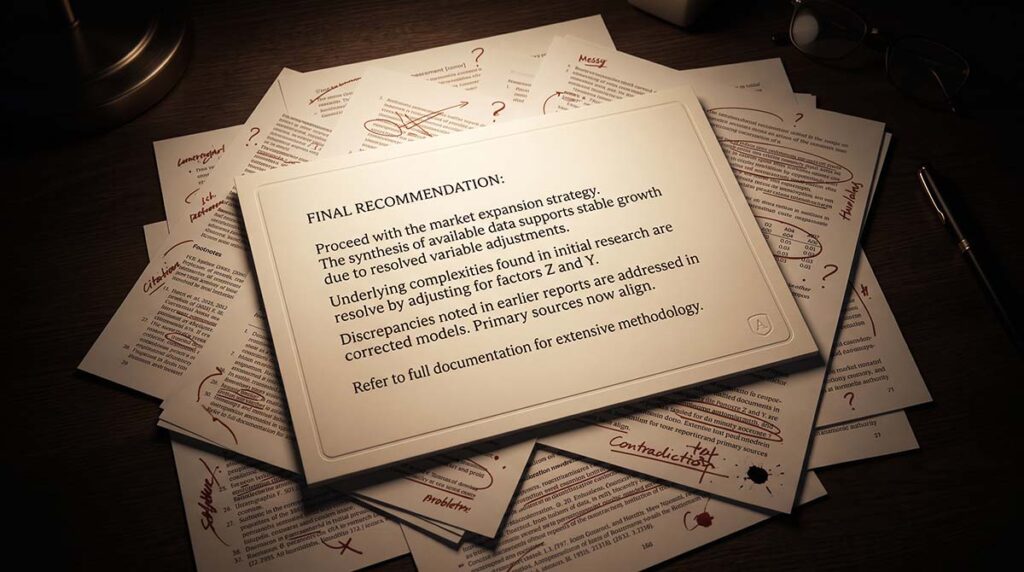
Answer-engine summaries carry influence because they change the psychology of research.
A search results page visibly presents plurality. The user sees competing sources. Contradiction is built into the interface. The page itself implies that judgment remains unfinished.
A conversational answer feels different. It speaks in a coherent voice. It reduces visible contradiction. It presents itself as a helpful synthesis. Even when sources are cited, the user often experiences the summary as the thing to trust, rather than one interpretation to inspect.
This is where representation evaluation enters the picture. People often evaluate the representation they’re given instead of interrogating the underlying source material. A confident summary becomes a stand-in for the market itself.
That behavior is efficient. Most people don’t want to become temporary experts every time they make a decision. They want enough confidence to proceed.
The answer engine provides that confidence.
The cost is that verification drops. The user is less likely to click through, compare sources, inspect original claims, or notice what was excluded. The interface creates the emotional experience of having done the research, even when the research has been mediated by a system whose judgment remains mostly invisible.
The Zero-Click Purchase Journey
The zero-click environment changes the role of the brand website.
In the old buyer journey, the research phase gave brands repeated chances to shape perception. A buyer might visit a homepage, read a comparison page, download a guide, skim a case study, check reviews, watch a demo, or encounter a brand’s own explanation of its value.
In the new journey, much of that can collapse into the answer interface. The buyer asks. The system summarizes. The shortlist appears. The buyer proceeds.
The brand website may still exist, but its role changes. It becomes less of a persuasion environment and more of a source object for machine interpretation. It is still written for humans, but it also has to be legible to systems that extract, compare, and verify.
Brands need machine-readable authority.
That doesn’t mean writing for robots in some crude SEO sense. It means creating a digital footprint that is structurally consistent, externally corroborated, technically legible, and semantically clear enough for machines to understand and trust.
The brand has to become verifiable.
Visibility Is No Longer Just Being Found

The old visibility question was simple: can buyers find you?
That question still matters, but it no longer carries the whole problem. A brand can be findable and still fail to be represented. It can be indexed and still fail to be selected. It can publish persuasive claims and still fail to be trusted by the system.
The new question is: can machines trust you? Machine trust is the system’s ability to verify claims against a broader evidentiary environment.
Can it understand what you do? Can it classify you correctly? Can it connect your claims across your website, documentation, reviews, profiles, listings, and third-party mentions? Can it find independent support for what you say about yourself? Can it distinguish your actual differentiation from your preferred positioning?
When the answer is no, the brand may never enter the decision environment at all.
That is why the line “you don’t lose the sale, you’re not in the room” is so powerful. It captures the new danger precisely. The failure happens before persuasion. Before comparison. Before objection handling. Before the buyer reaches the brand.
The failure happens at the level of representation.
The Real Change Is Authority
A tactical version of this conversation includes structured data, documentation, review strategy, third-party citations, community presence, schema, content architecture, and answer-engine optimization. Those tactics matter.
But tactics are downstream of the deeper shift.
Authority has moved closer to the point of synthesis. The buyer no longer has to assemble the market manually. The system assembles it for them. That gives the answer engine enormous power over what feels true, credible, relevant, and worth considering.
For brands, the implication is uncomfortable but clarifying. You can’t rely only on saying who you are. You need a digital environment that allows independent systems to verify who you are.
That means the future of brand visibility will be less about expressive control and more about evidentiary coherence. The strongest brands will still need voice, identity, and positioning. But those elements will need a machine-readable structure of proof beneath them.
The answer engine doesn’t care how much effort went into the story.
It cares whether the story can survive synthesis.
The World That No Longer Decides
The decision structure has changed.
For two decades, brands competed for attention in an open discovery environment. The buyer searched, compared, clicked, and decided. Now, the machine retrieves, synthesizes, and frames the conclusion. The buyer may still make the final decision, but the field of possible decisions has already been shaped.
That is why the old question no longer carries enough weight.
Can buyers find you? Yes, maybe.
But can machines trust you?
That is the question now sitting underneath brand visibility, digital discovery, buyer research, and market representation. A brand that hasn’t answered it may be optimizing for a world that no longer decides.
Frequently Asked Questions
How do answer engines change brand visibility?
Answer engines change brand visibility by moving discovery from open search results to synthesized conclusions. A brand now competes to be included in the answer itself after the system has retrieved, filtered, weighted, and interpreted the available evidence.
What is Retrieval Augmented Generation?
Retrieval Augmented Generation, or RAG, is the process where an AI system searches external sources for relevant information before generating its response. In brand discovery, that matters because the model draws on current material, evaluates it, and synthesizes a single answer
What is tone flattening in AI search?
Tone flattening happens when an AI system strips a brand’s distinctive voice, personality, and positioning from its summary because those qualities can’t be verified as factual claims. The result may be technically accurate and commercially damaging: a differentiated brand gets compressed into a generic functional description.
What does representation evaluation mean?
Representation evaluation describes the tendency to accept a synthesized summary as objective reality rather than one interpretation of available sources. In an AI search environment, that matters because fluent answers feel authoritative, so users may trust the representation without checking the evidence behind it.
What is a zero-click environment?
A zero-click environment is a search condition where the user gets enough information inside the AI interface that they have no reason to visit an external website. For brands, this removes the old research moment where buyers visited the site, read the positioning, and allowed the company to make its case.
Why does external corroboration matter more in AI search?
External corroboration matters because answer engines tend to trust independent evidence more than self-reported marketing claims. Technical documentation, independent reviews, community discussion, third-party references, and consistent signals across the web give the system something to verify.
Is this just another version of SEO?
SEO still matters, but this shift is deeper than ranking. Traditional search asked whether a buyer could find a brand. Answer engines ask whether a machine can trust, summarize, and represent that brand inside a synthesized conclusion. That is an authority problem, not just a traffic problem.
What should brands do differently in the answer-engine era?
Brands need to build digital footprints that are machine-readable, structurally consistent, and independently corroborated. Voice and positioning still matter, but they need evidence a system can verify. The practical goal is to be discoverable and survive synthesis without being flattened or excluded.